quality score is the single most misunderstood number in google ads. advertisers spend hours tweaking bids while ignoring the 1-10 score next to each keyword that can literally cut their CPC in half.
understanding quality score is not optional. it is the mechanism that decides whether you pay $5 or $12 for the same click, whether your ad shows in position 1 or position 4, and whether your campaign becomes profitable or burns through budget. this article breaks down what quality score actually measures, how google calculates it, and the specific actions that raise it.
what quality score actually is
quality score is a 1-10 rating google assigns to every keyword in your account, visible in the keyword reports column. it reflects google’s estimate of how relevant and useful your ads and landing pages are to users searching for that keyword.
the reason it matters: quality score directly modifies how much you pay per click and where your ad appears. the math google runs in every auction:
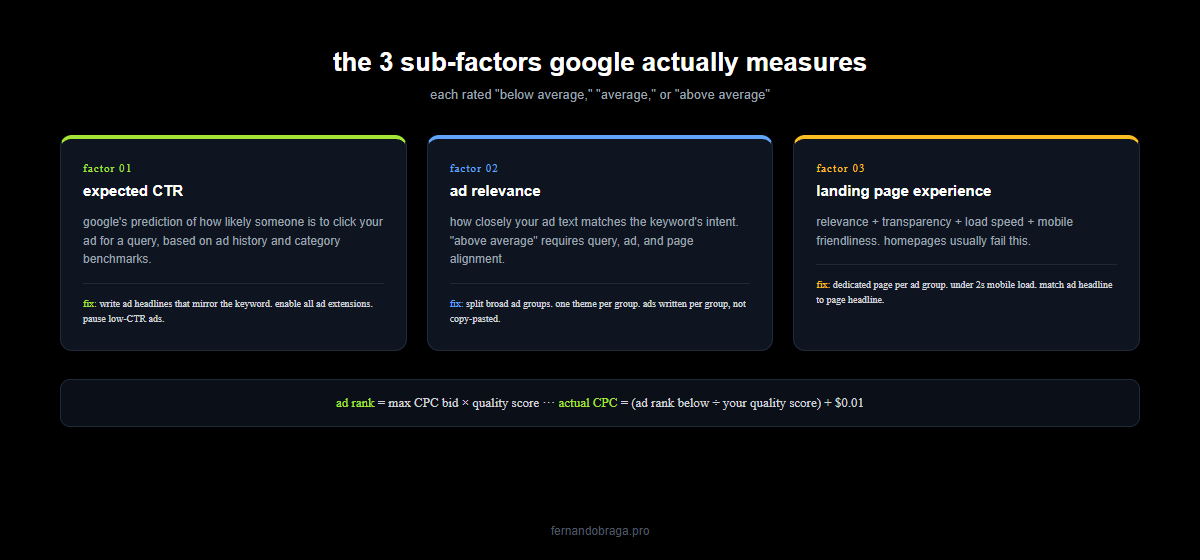
- ad rank = max CPC bid × quality score (simplified; actual formula includes expected impact of ad extensions and other factors)
- your actual CPC = (ad rank of the advertiser below you / your quality score) + $0.01
what this means in practice: at the same ad position, an advertiser with a 10/10 quality score pays roughly half of what an advertiser with a 5/10 pays. google literally gives you a discount for being relevant.
the 3 sub-factors that determine your quality score
google tells you which components feed into quality score directly in the keyword status column:
- expected click-through rate (CTR)
- ad relevance
- landing page experience
each is rated “below average,” “average,” or “above average.” you need “above average” or at least “average” across all three to get into the 7-10 quality score range.
expected CTR
google estimates how likely someone is to click your ad for a given query. it compares your ad to historical CTR benchmarks for similar ads in the same category.
what raises expected CTR:
- ad headlines that mirror the keyword exactly
- specific benefits and differentiators in the description
- clear calls to action
- using all available ad extensions (sitelinks, callouts, call, location, image)
- removing underperforming ads and letting top performers accumulate impressions
expected CTR is partly historical. new keywords and ads get benchmarked against the category average until they have enough data to be judged on their own performance. this is why launching new campaigns with tightly written ads matters — google starts you closer to above average.
ad relevance
this is google’s measure of how closely your ad text matches the keyword’s intent. “above average” means the query, the ad, and the landing page all speak to the same need.
the fix here is structural: tight ad groups with narrow keyword themes, and ads written specifically for each ad group rather than copy-pasted across groups.
a common pattern that kills ad relevance: one ad group contains “emergency dentist,” “cosmetic dentist,” and “dental implants,” with one generic ad for all three. google sees a mismatch between specific queries and vague ads. the fix: split into three separate ad groups with ads written for each intent.
landing page experience
google evaluates your landing page on three dimensions:
- relevance — does the page content match what the ad promised?
- transparency and navigability — is it easy to find what you are looking for? can you contact the business?
- page experience — how fast does the page load, is it mobile-friendly, does it work without errors?
landing page experience is where most accounts underperform. sending every ad to the homepage looks lazy to google because a homepage cannot be highly relevant to 50 different keyword intents. slow pages penalize experience even when content is strong.
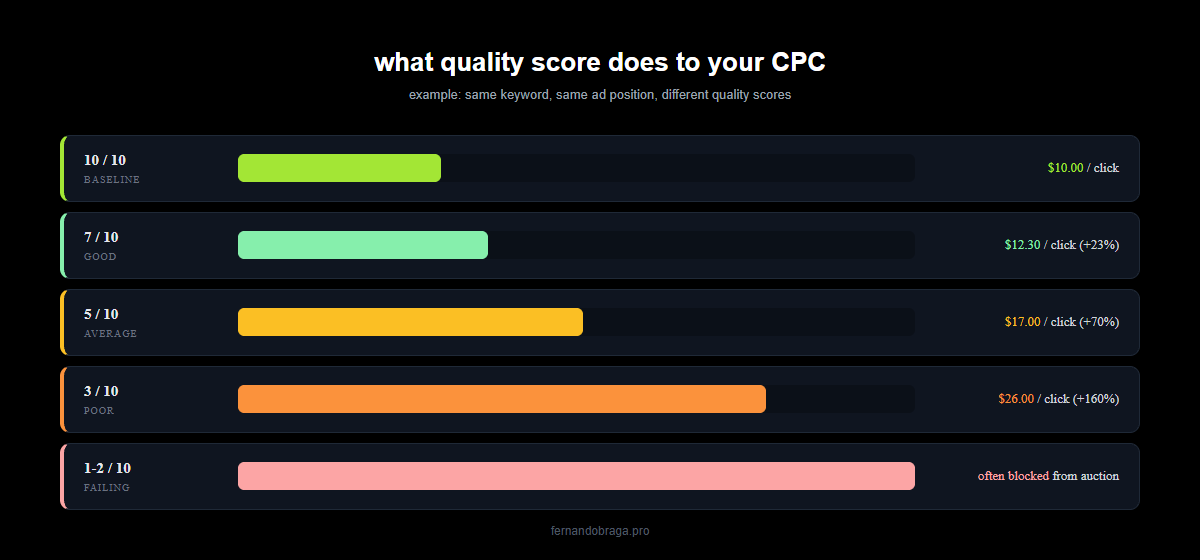
the cost impact of quality score
rough numbers across accounts i have audited:
- quality score 10: baseline CPC
- quality score 7: ~15-25% higher CPC
- quality score 5: ~50-70% higher CPC
- quality score 3: ~2-3x higher CPC
- quality score 1-2: often fails to even enter the auction
for a keyword with $10 CPC at quality score 10, an advertiser at quality score 5 pays roughly $15-17 for the same position. over a $5,000/month budget, that is $2,500-3,500 wasted purely because of quality score gap.
the 5 practical actions that raise quality score
1. split ad groups until they are painfully narrow
every ad group should target one tight theme. “emergency dentist [city]” gets its own group. “teeth whitening [city]” gets its own. “dental implants [city]” gets its own.
how narrow is narrow enough? the ideal is 5-15 closely related keywords per ad group, all variations of the same core intent. “emergency dentist,” “emergency dental care,” “emergency tooth extraction,” “dentist open now” all belong together because the intent is identical. “teeth whitening” does not, because the intent is different.
most accounts have ad groups with 50-200 keywords spanning multiple intents. splitting those is the single highest-leverage move available.
2. write ads that echo the exact keyword
if the keyword is “emergency dentist chicago,” the ad headline should say “emergency dentist chicago” literally. not “dental services” or “your local dental office.”
this is called dynamic keyword insertion when automated, but manual matching works better because it lets you write around the keyword rather than stuffing it awkwardly. the point is: when a user searches for something specific, they should see an ad that says exactly that something.
google rewards this alignment with higher ad relevance scores and higher expected CTR.
3. match landing pages to ad groups
each ad group points to a dedicated landing page that matches the intent. the landing page headline mirrors the ad headline. the content addresses exactly what the search was about.
example: ad group “dental implants chicago” → landing page with headline “dental implants in chicago” → content about the implant procedure, pricing, consultation booking, patient stories specific to implants.
sending all ad traffic to your homepage is the single most common quality score killer. a homepage trying to be relevant to 40 keyword intents ends up relevant to none.
4. fix page speed (especially on mobile)
page experience is a direct quality score input. google’s pagespeed insights gives you scores from 0-100 on mobile and desktop. anything below 60 on mobile hurts quality score. above 90 helps.
common fixes:
- compress and lazy-load images
- remove unused css and javascript (page builders are usually the culprit here)
- enable browser caching and gzip compression
- use a good host (cheap shared hosting often cannot deliver sub-2-second load times)
- minimize third-party scripts (chat widgets, tracking pixels, ad retargeting all add weight)
a slow site also directly tanks conversion rate, so this fix doubles as a CPL improvement. under 2 seconds on mobile is the target.
5. use all available ad extensions
ad extensions (now called assets) do not directly raise quality score, but they increase the “ad rank” calculation in the auction, which compounds with quality score to give you better position at the same bid.
what to enable:
- sitelinks — 6+ links to specific pages on your site
- callouts — short benefit statements (“licensed & insured,” “free consultation,” “24/7 response”)
- structured snippets — lists of services, brands, or categories
- call extensions — phone number visible on the ad, tappable on mobile
- location extensions — google business profile address visible on the ad
- image extensions — visual content next to the ad text
- promotion extensions — specific offers with end dates
accounts with 5+ active extensions consistently outperform accounts with 0-2 extensions at the same quality score. the effect compounds over time as google learns which extensions drive the most engagement.
what does NOT raise quality score (despite the myths)
paying more per click. bidding higher can get you better position, but it does not raise quality score itself. and paying more per click at a low quality score is paying a premium on top of a premium.
having more clicks total. volume alone does not help. a high-CTR keyword with low volume scores better than a low-CTR keyword with high volume.
running ads longer. age of an ad is a minor factor. a new well-targeted ad scores higher than an old poorly-targeted one.
buying traffic from other sources to boost ad relevance. this does not work. quality score is computed independently per keyword based on your actual google ads performance.
the 30-day quality score audit
week 1: open your keyword report. sort by quality score. identify every keyword at 5 or below. flag them.
week 2: for each low-QS keyword, check the three sub-factors. a “below average” on expected CTR means the ad copy is wrong. “below average” on ad relevance means the ad group is too broad. “below average” on landing page experience means the page is wrong or slow.
week 3: fix the biggest wins first. split oversized ad groups. write new ads for each narrowed group. create dedicated landing pages for top 10 ad groups. address page speed issues.
week 4: monitor. quality score updates take 7-14 days to reflect new performance. expect to see 1-2 point increases within 30 days, 3-4 point increases within 60 days if the fundamentals changed.
a well-executed quality score audit on a neglected account typically saves 25-40% of ad spend within 90 days without touching a single bid.
when quality score stops being enough
there is a ceiling. a keyword at 10/10 quality score is as efficient as it can be at the ad level. beyond that, further cost improvements come from:
- tighter conversion tracking that lets smart bidding optimize better
- better close rate on the leads you generate (lowers effective CPA)
- shifting budget from lower-value campaigns to higher-value ones
- negative keywords to eliminate waste further
quality score is the starting point for cost efficiency, not the end state.
next step
if you want a specific audit of your quality score distribution, which sub-factors are dragging each keyword down, and the 3-5 highest-leverage fixes for your account, start with a free audit. i pull the actual data and show you exactly where the score is hurting you and how to raise it.