
most dental practices rely on referrals and word of mouth. that works, but it’s slow and unpredictable. google ads puts your practice in front of people actively searching for a dentist right now.
the difference between google ads and social media marketing is intent. someone searching “dentist near me” or “emergency tooth extraction” isn’t browsing. they need a dentist and they’re ready to book.
this guide covers everything you need to set up google ads for your dental practice: campaign structure, keyword strategy, budgets, ad copy, landing pages, and tracking.
why google ads works for dental practices
dental services have a few characteristics that make google ads especially effective:
- high intent searches. people search for dentists when they need one. not when they’re casually browsing.
- geographic targeting. you only pay for clicks from people in your service area. no wasted spend on people 50 miles away.
- high patient lifetime value. a new patient is worth thousands of dollars over time. a $30 click that brings a patient worth $3,000+ is a great investment.
- immediate visibility. seo takes months. google ads puts you at the top of search results on day one.
if you’re already investing in google ads management, understanding how the platform works helps you evaluate whether your campaigns are performing well.
how much dentists should spend on google ads
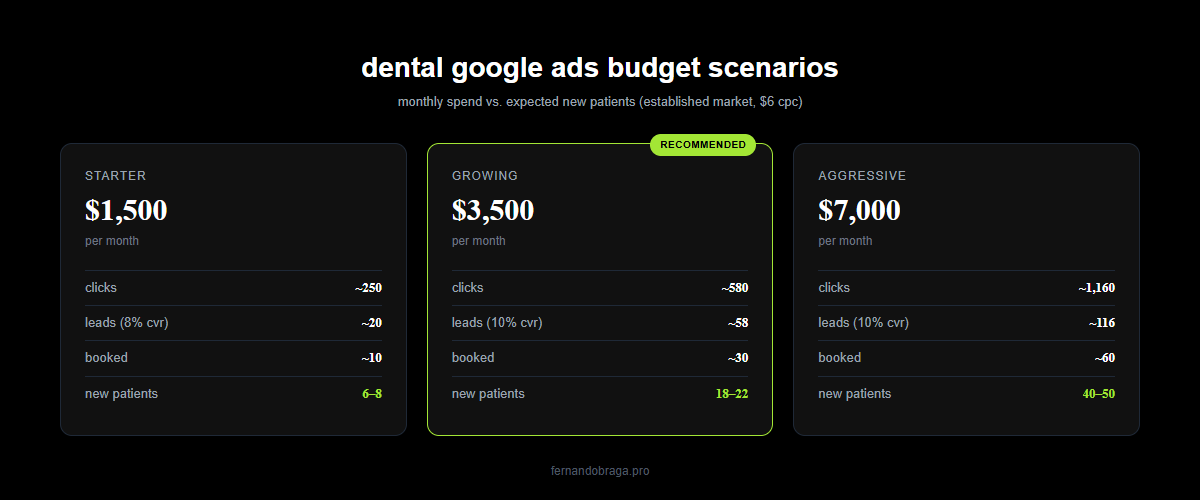
budget depends on your market, competition level, and how many new patients you want per month. here’s what to expect.
typical cpc for dental keywords
cpc (cost per click) is the amount you pay each time someone clicks your ad. dental keywords vary a lot depending on the service and location:
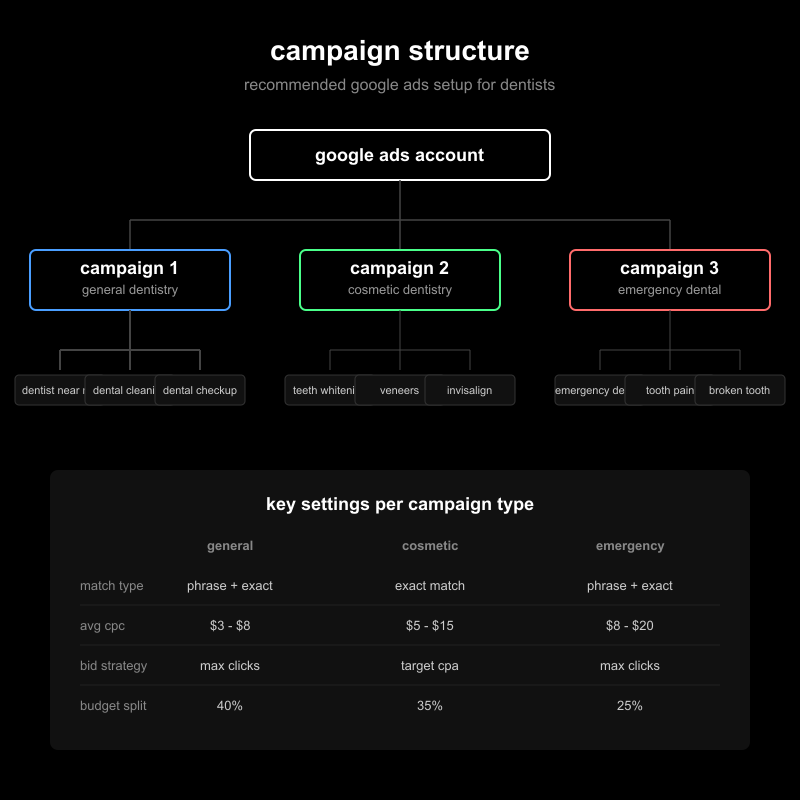
- general dentistry (“dentist near me”, “dental cleaning”): $3 to $8 per click
- cosmetic dentistry (“teeth whitening”, “dental veneers”, “invisalign”): $5 to $15 per click
- emergency dental (“emergency dentist”, “tooth pain”): $8 to $20 per click
cosmetic and emergency keywords cost more because the procedures are higher value. that’s normal and expected.
for a detailed breakdown of costs across different industries, check my guide on how much google ads costs for local businesses.
recommended starting budget
for most dental practices in mid-size markets, here’s a reasonable starting point:
- minimum viable budget: $1,000 to $1,500/month. enough to get data and start optimizing.
- competitive market budget: $2,500 to $5,000/month. needed in larger cities with more competition.
- growth budget: $5,000+/month. for practices ready to scale aggressively.
start on the lower end. run campaigns for 30 to 60 days, analyze the data, then scale what works. don’t throw $5,000/month at google ads before you know which campaigns convert.
the best campaign structure for dentists
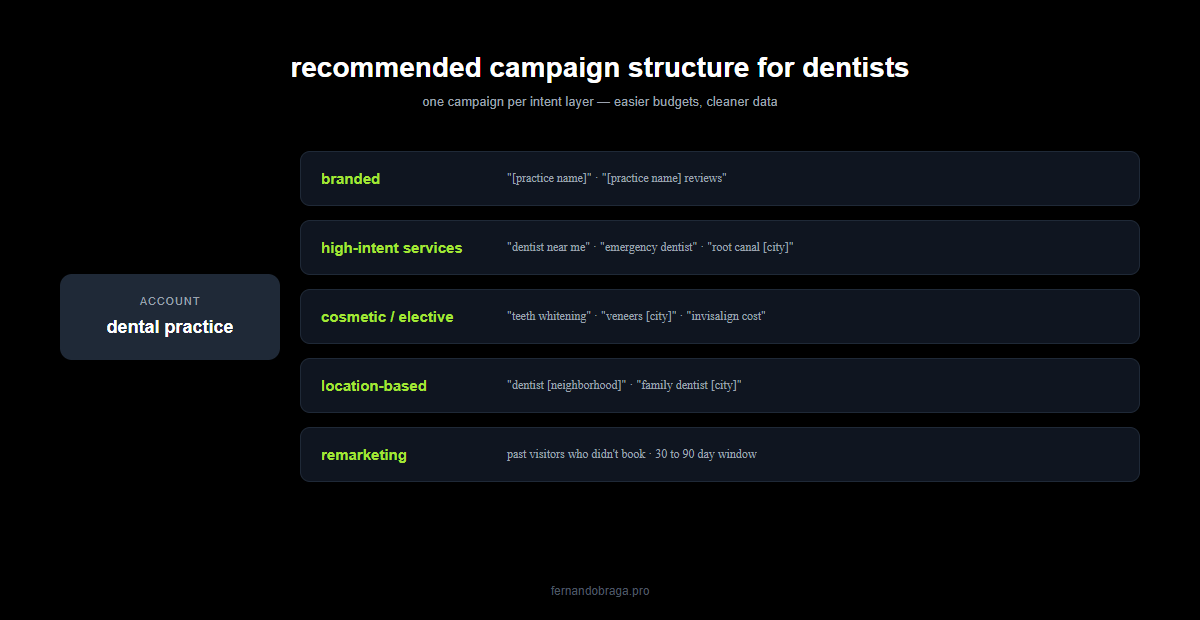
campaign structure is where most dental practices go wrong. they put everything in one campaign with broad keywords and hope for the best. that wastes money.
campaign types to use
for dental practices, search campaigns should be your foundation. here’s the recommended structure:
- campaign 1: general dentistry. keywords like “dentist near me”, “dental office [city]”, “dental cleaning near me”. this is your bread and butter campaign.
- campaign 2: cosmetic dentistry. keywords like “teeth whitening [city]”, “dental veneers near me”, “invisalign dentist”. higher cpc but higher value procedures.
- campaign 3: emergency dental. keywords like “emergency dentist”, “tooth pain dentist near me”, “broken tooth repair”. these convert fast because the need is urgent.
separating campaigns by service type lets you control budgets independently. if emergency keywords are eating your budget but cosmetic procedures are more profitable, you can adjust without affecting other campaigns.
avoid performance max campaigns until your search campaigns are profitable. performance max is a black box, and you need search data first to understand what works. this is one of the most common google ads mistakes local businesses make.
keyword strategy by service
each campaign needs a different keyword approach:
general dentistry: use phrase match and exact match. focus on location-based terms. “dentist in [city]”, “[city] dental office”, “family dentist near me”. these have moderate competition and good volume.
cosmetic dentistry: use exact match primarily. these keywords are expensive, so you want tight control. “teeth whitening [city]”, “porcelain veneers dentist [city]”. add procedure-specific terms your practice actually offers.
emergency dental: use phrase match and exact match. urgency keywords like “emergency dentist open now”, “same day dental appointment”. these searchers convert quickly, often calling directly from the ad.
for all campaigns, build a strong negative keyword list from day one. exclude terms like “jobs”, “salary”, “school”, “diy”, “free”, and “how to become”. these searches waste your budget on people who aren’t looking for dental care.
writing dental ads that convert
google gives you limited space. every word needs to earn its place. here’s what works for dental ads:
headlines that work:
- include the service and city: “Emergency Dentist in [City]”
- mention specific benefits: “Same Day Appointments Available”
- add social proof: “5-Star Rated Dental Practice”
- create urgency when appropriate: “Open Evenings & Weekends”
descriptions that convert:
- lead with what patients care about: pain-free experience, modern equipment, insurance accepted
- include a clear call to action: “Call Now to Book” or “Schedule Online Today”
- mention specific differentiators: financing options, sedation dentistry, bilingual staff
extensions to use:
- call extensions: essential. many dental patients prefer calling over filling out forms.
- location extensions: shows your address and map pin. builds trust and helps with “near me” searches.
- sitelink extensions: link to specific service pages (whitening, implants, emergency).
- callout extensions: “Free Consultation”, “Insurance Accepted”, “0% Financing”.
landing pages that turn clicks into appointments
sending ad traffic to your homepage is a waste of money. each campaign should point to a dedicated landing page (or at minimum, the relevant service page).
and the page has to load fast. this is the hidden multiplier most dental practices miss: if you pay $8 per click for “dentist near me” and your mobile site takes 5 seconds to load, more than half of those visitors leave before the page renders. you paid for 100 clicks. only ~47 reach your offer. effective cost per visitor who actually saw your page: $17, not $8.
page speed under 2 seconds on mobile is non-negotiable for paid traffic. a site built for conversion pays for itself in saved ad spend within a quarter, and google also rewards you with a better quality score, which lowers your cpc on top.
a good dental landing page includes:
- clear headline matching the ad they clicked. if the ad says “emergency dentist”, the page should say “emergency dentist” too.
- phone number visible at the top of the page. large, clickable on mobile.
- booking form above the fold. name, phone, preferred time. keep it short.
- trust signals: google reviews, before/after photos, certifications, years in practice.
- fast load time. if your page takes more than 3 seconds to load on mobile, you’ll lose patients before they even see your content.
i helped a dermatology clinic in a similar healthcare niche improve their conversion rate significantly by restructuring their landing pages around these principles. the same approach works for dental practices.
tracking roi: what metrics actually matter
roi (return on investment) tracking is where dental practices either prove their ads work or fly blind. here are the metrics that matter:
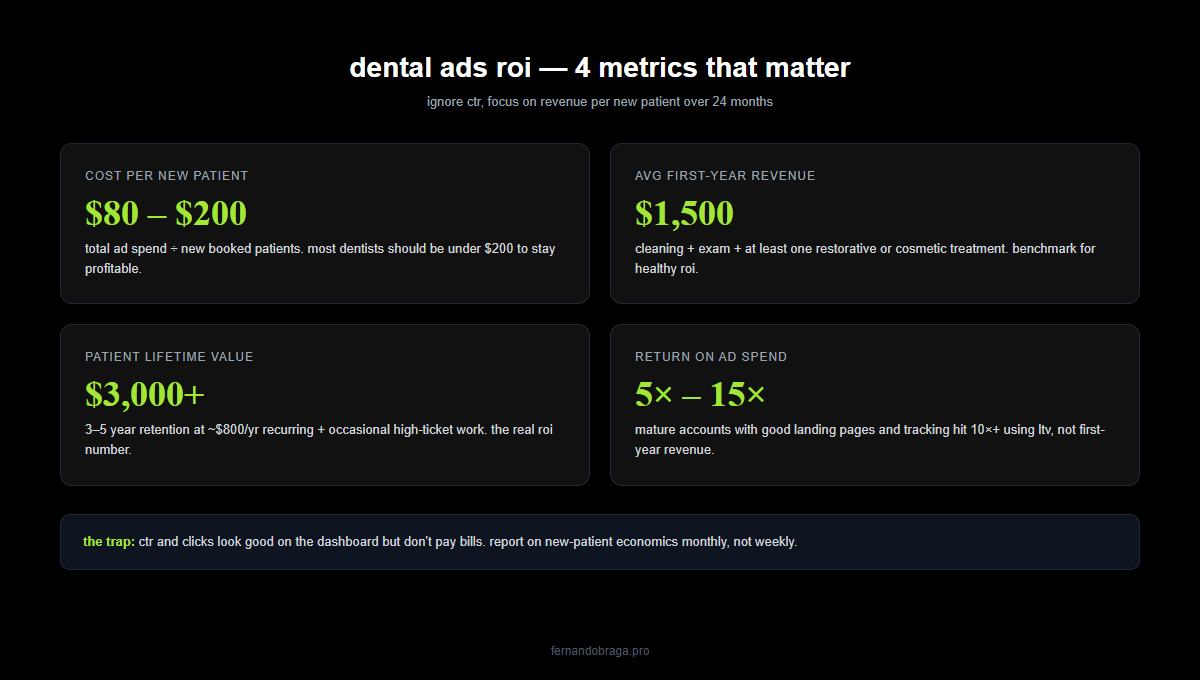
- cost per lead: how much you spend to get one phone call or form submission. for dental, aim for $30 to $80 per lead depending on the service.
- cost per new patient: not every lead becomes a patient. if your close rate is 50%, double your cost per lead to get the real number.
- conversion rate: percentage of clicks that become leads. 5% to 15% is typical for dental landing pages. below 5% means your landing page needs work.
- phone calls vs form fills: track both. many dental practices get 60% to 70% of conversions via phone calls. if you’re not tracking calls, you’re missing most of your data.
essential tracking setup:
- google ads conversion tracking on all forms
- call tracking with a dedicated number for ads
- google analytics 4 connected to google ads
- google tag manager for clean event tracking
without proper tracking, you’re guessing. and guessing with a $2,000/month ad budget gets expensive fast.
common mistakes dental practices make with ads
after managing campaigns for healthcare businesses, these are the mistakes i see most often:
- one campaign for everything. mixing general, cosmetic, and emergency keywords in one campaign makes optimization impossible. separate them.
- broad match keywords. broad match burns budget on irrelevant searches. start with phrase and exact match only.
- no negative keywords. without negatives, you’ll pay for clicks from people searching “dental assistant jobs” or “dentist salary”. add negatives before you launch.
- sending traffic to the homepage. your homepage isn’t designed to convert ad traffic. use service-specific landing pages.
- ignoring mobile. over 60% of dental searches happen on mobile. if your landing page doesn’t work perfectly on a phone, fix that first.
- no call tracking. phone calls are the primary conversion for dental practices. if you only track form submissions, your data is incomplete.
- giving up too early. google ads needs 30 to 60 days of data before you can make informed decisions. don’t kill a campaign after one week.
for a deeper dive into these pitfalls, read my full guide on google ads mistakes that waste your budget.
ready to start getting more patients from google ads? request a free audit of your current campaigns (or get a custom strategy if you’re starting from scratch).