
if you run a service business (dentist, lawyer, plumber, clinic), your next customer is probably searching google right now. the question is: do they find you or your competitor?
that’s where local seo comes in. it’s the process of making your business visible when people nearby search for what you do. no paid ads required.
this guide breaks down what local seo actually is, how it works, and how to start using it to bring in more customers.
local seo explained in plain english
local seo (search engine optimization) is the practice of optimizing your online presence so your business appears in local search results on google.
when someone searches “dentist near me” or “family lawyer in rio de janeiro,” google shows results based on location. local seo is how you influence which businesses show up in those results.
it involves three main areas:
- your google business profile (the listing that appears on google maps)
- your website (optimized for local keywords and user experience)
- your online reputation (reviews, citations, mentions across the web)
unlike traditional seo, which focuses on ranking nationally or globally, local seo targets people in a specific geographic area. for service businesses, that’s exactly where your customers are.
how local search results actually work
when you search for a local service on google, the results page is divided into distinct sections. understanding each one helps you know where to focus your efforts.

the map pack
this is the box with three business listings and a map that appears near the top of search results. it pulls information directly from google business profiles.
the map pack gets a huge share of clicks for local searches. appearing here means your business name, reviews, phone number, and hours are visible before anyone even visits your website.
to rank in the map pack, you need a well-optimized google business profile with accurate information, consistent posting, and genuine customer reviews.
organic local results
below the map pack, you’ll see the standard blue link results. these are the regular organic listings, but google filters them based on local relevance when the search has local intent.
ranking here requires a fast, well-structured website with content that matches what local customers are searching for. technical seo, on-page optimization, and quality backlinks all play a role.
local service ads
at the very top of some searches, google shows local service ads (LSAs). these are paid placements where businesses pay per lead, not per click. they include a “google guaranteed” or “google screened” badge.
LSAs are separate from regular google ads and from organic seo. they work well alongside a local seo strategy, but they’re not a replacement for it. ads stop the moment you stop paying. seo compounds over time.
the three ranking factors google cares about
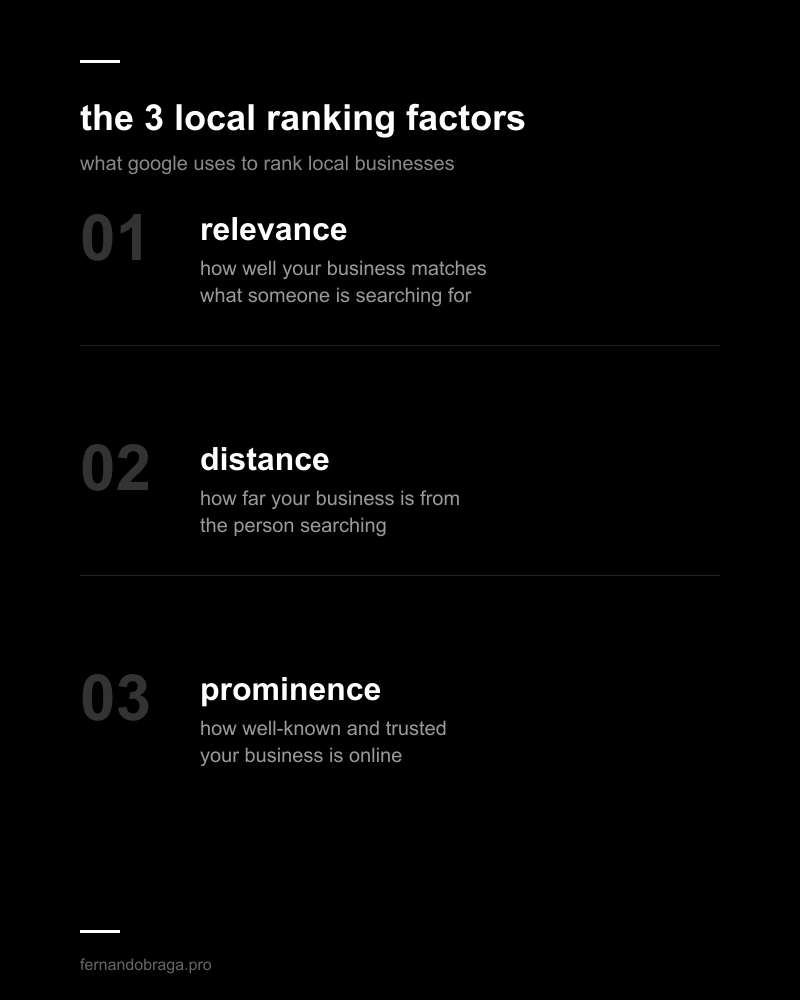
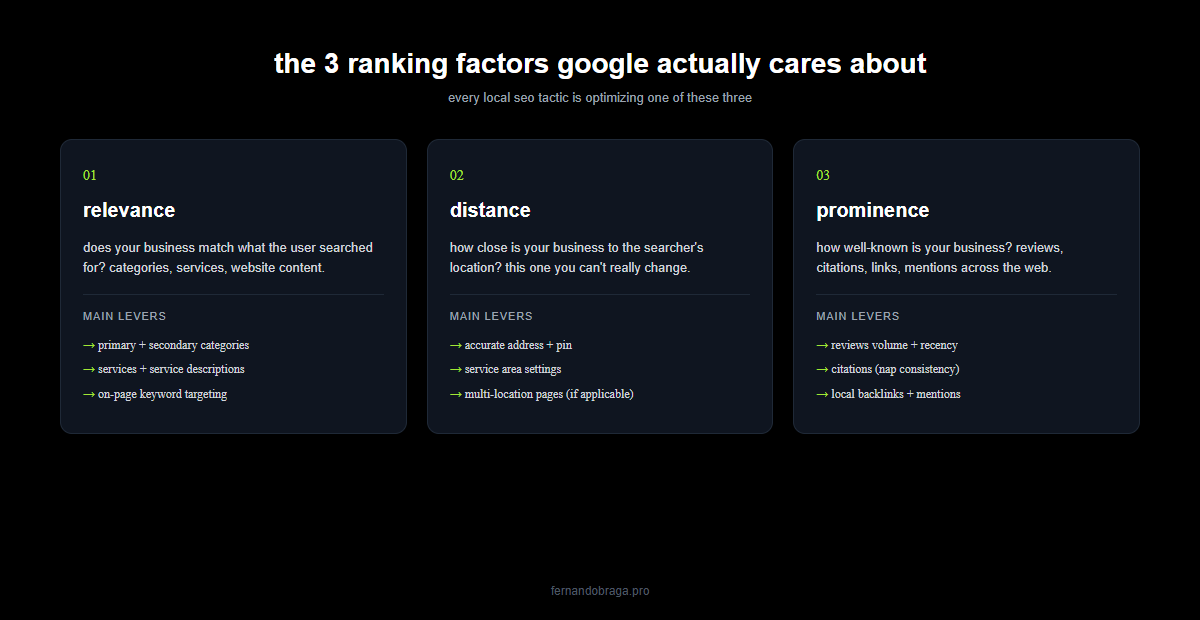
google has publicly stated the three main factors it uses to determine local search rankings. every local seo decision you make ties back to one of these.
relevance
relevance measures how well your business matches what someone is searching for. google looks at your business category, the services listed on your profile, your website content, and the keywords you target.
if someone searches “pediatric dentist” and your profile only says “dentist,” you’re less relevant than a competitor who specifically lists pediatric dentistry. being specific and detailed in your descriptions matters.
distance
distance is how far your business is from the person searching (or from the location they included in their search). this is the one factor you can’t directly control.
you can’t move your office closer to every potential customer. but you can make sure your address is correct, your service areas are properly defined, and your content mentions the neighborhoods and cities you serve.
prominence
prominence is how well-known and trusted your business is online. google measures this through:
- reviews: quantity, quality, and how often you get new ones
- citations: mentions of your business name, address, and phone number across directories
- backlinks: other websites linking to yours
- engagement: how users interact with your profile and website
a business with 200 reviews and mentions across 50 directories will outrank a competitor with 10 reviews and no directory presence, assuming relevance and distance are equal.
local seo vs traditional seo. what’s different
traditional seo and local seo share the same foundation (good content, technical optimization, backlinks), but the execution differs in important ways:
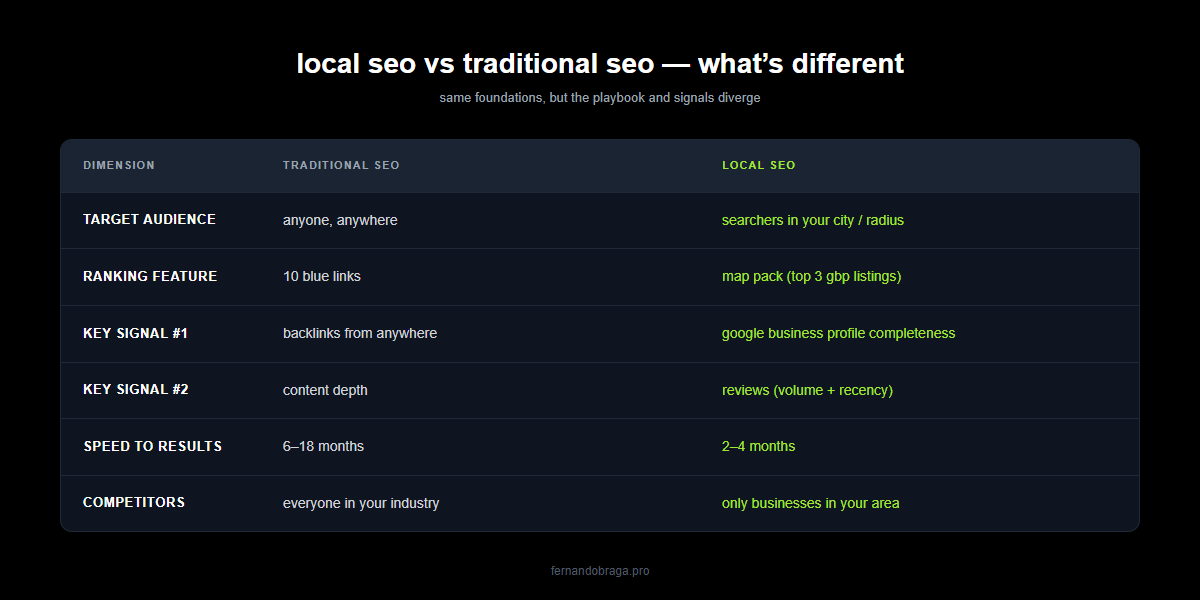
- google business profile: local seo depends heavily on your GBP. traditional seo doesn’t use it at all.
- geographic targeting: local seo targets specific cities, neighborhoods, and service areas. traditional seo targets topics regardless of location.
- reviews and citations: these are critical ranking signals for local seo. for traditional seo, they have minimal impact.
- competition scope: with local seo, you’re competing against other businesses in your area. with traditional seo, you’re competing against everyone on the internet.
- search intent: local searches have immediate, action-oriented intent (“book an appointment,” “call now”). traditional searches are often informational.
for service businesses with a physical location or defined service area, local seo delivers a much higher return because you’re reaching people ready to take action.
who benefits most from local seo
local seo works for any business that serves customers in a specific area. but some industries see especially strong results:
- healthcare: dentists, doctors, clinics, therapists, veterinarians
- legal: family lawyers, personal injury attorneys, immigration lawyers
- home services: plumbers, electricians, roofers, landscapers
- beauty and wellness: salons, spas, dermatologists, nutritionists
- automotive: mechanics, body shops, dealerships
- professional services: accountants, real estate agents, financial advisors
the common thread: these businesses rely on customers within a reasonable driving distance. if that describes your business, local seo isn’t optional. it’s how people find you.
how to get started (without overwhelm)
you don’t need to do everything at once. start with these five steps and build from there:
- claim and optimize your google business profile. fill out every field. add photos. choose the right categories. this is the single highest-impact action you can take. here’s a step-by-step guide.
- make sure your website loads fast and works on mobile. over 60% of local searches happen on phones. if your site is slow or hard to navigate, people bounce.
- add location-specific content to your website. mention your city and service area on your homepage, service pages, and meta descriptions. don’t stuff keywords, just be clear about where you operate.
- get reviews from real customers. ask every satisfied customer for a google review. respond to every review you receive, good or bad.
- submit your business to relevant directories. start with google, then move to yelp, facebook, and industry-specific directories. keep your name, address, and phone number consistent everywhere.
for a more detailed roadmap, check out my complete local seo checklist with every step organized by priority.
if you want to know exactly where your business stands right now, request a free audit. i’ll analyze your google presence, website, and competitors, then send you a clear report with what to fix first.