most law firms treat their google business profile as an afterthought. the address is right, the phone number works, and that is it. meanwhile the firm 4 blocks away is taking the case because their profile does the selling before the prospect ever clicks the website.
gbp is different for law firms than for any other local business. bar association rules constrain what you can claim. testimonials have extra compliance layers. the “specialist” label that dentists and plumbers use freely is literally regulated in most US states. this article covers the gbp playbook that actually works inside those constraints.
why gbp matters more for lawyers than most firms admit
when someone searches “family lawyer [city]” or “personal injury attorney near me,” google shows the map pack (3 local results) above every organic result. for high-intent legal searches, 60-70% of clicks go to the map pack. if your firm is not in those 3 slots, you are competing for the leftover 30%.
and unlike web ranking, which takes 6-18 months of content and links, gbp ranking can move in 30-60 days with the right inputs. it is the fastest lever a law firm has for local visibility.
the 7 gbp fields that matter most for law firms
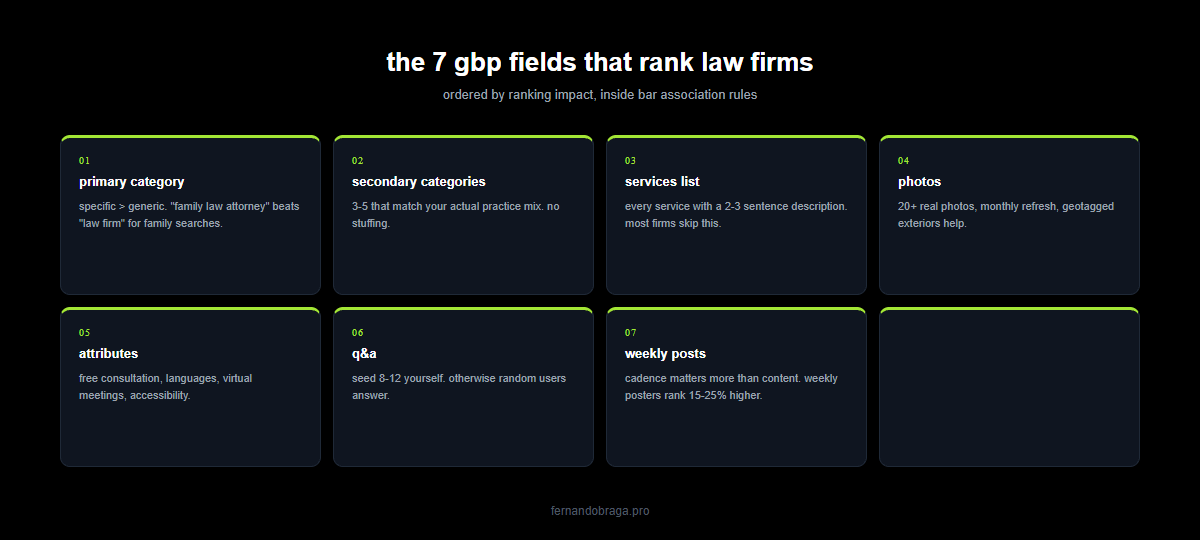
1. primary category
the single most important field on your profile. the primary category determines which queries google considers you relevant for.
for law firms, the categories available (and when to use which):
- “law firm” — use when you are a multi-practice firm with more than 3 core practice areas
- “personal injury attorney” — use if 60%+ of your revenue is PI, even if you do other work
- “family law attorney” — same rule for divorce-focused practices
- “criminal justice attorney” — for criminal defense firms
- “estate planning attorney” — for estate-focused practices
- “immigration attorney” — for immigration-focused firms
the specific categories rank better than “law firm” for their matching searches. if you use “law firm” but 80% of your revenue is divorce, you are invisible on “family law attorney [city]” searches where specific-category firms rank above you.
the most common mistake: picking “lawyer” or “legal services” (generic) when a specific category applies. specificity wins ranking.
2. secondary categories
add 3-5 secondary categories covering your actual practice areas. a family law firm that also does estate planning adds “estate planning attorney” as secondary. a criminal defense firm that handles DUIs adds “DUI attorney.”
do not stuff categories you do not practice. google detects mismatches between categories and content over time and can suppress your profile in low-relevance queries.
3. services list
this is the field most law firms ignore and it is massive leverage.
list every specific service you offer with a 2-3 sentence description each. not “family law.” spell out: “divorce representation,” “child custody disputes,” “spousal support modifications,” “prenuptial agreements,” “mediation services.”
for each service, add 1-2 sentences that mirror how a prospect might describe what they need. this helps google match you to long-tail queries that generic category labels miss.
4. photos (with compliance awareness)
minimum 20 photos, refreshed monthly. what works for law firms:
- office exterior with street view and signage visible
- reception area (clean, professional, not staged)
- conference rooms where client meetings happen
- attorney headshots, credentials visible in background (diploma walls work)
- team photos (even if small, builds trust)
- community involvement (bar association events, pro bono work, industry speaking)
avoid: stock photos of courthouses you never went to, gavel-on-books stock imagery, any photo that could be mistaken for generic legal marketing.
one photo hack that moves rankings: geotagged exterior photos. when you take office photos with GPS metadata intact, google reads the coordinates and confirms the listing’s physical presence. it is a small signal but it reinforces your legitimacy.
5. attributes
gbp has industry-specific attributes for law firms. enable the ones that apply:
- free consultation (huge for PI, family, criminal)
- online appointments
- virtual appointments available
- languages spoken (especially in immigration or multilingual markets)
- accessibility features (wheelchair accessible, parking)
- payment options (credit cards, online payment, payment plans)
these attributes appear in the profile and in some cases directly influence which queries show you. “spanish-speaking lawyer near me” filters to profiles with spanish listed as a language.
6. the q&a section
the q&a field on gbp is public-facing and few law firms touch it. here is the opportunity:
seed your own 8-12 questions that prospects commonly ask. answer them yourself. examples for a family law firm:
- “how much does a divorce cost?”
- “do i need a lawyer for an uncontested divorce?”
- “what if my spouse wants to contest?”
- “how long does divorce take in [state]?”
- “do you offer free consultations?”
if you do not seed these, competitors or random users will, and the answers will not help your profile. if you answer your own questions (disclosure: google allows this, just be transparent), you control the narrative and capture long-tail search queries the answers contain.
7. posts (weekly discipline)
gbp posts are the most underused feature. profiles that post weekly rank 15-25% better than equivalent profiles that post monthly, in my experience tracking legal clients.
what to post:
- case outcome updates (within bar rules — no specific compensation figures in most states)
- new services or practice area expansions
- attorney recognitions, awards, bar admissions
- educational content (“3 things to know before filing for divorce”)
- community involvement
- office news (new associate, moved locations, expanded hours)
each post stays live for 7 days then archives. the signal google cares about is the cadence, not the individual post. publishing once a week signals an active business.
reviews for law firms: the compliance-aware playbook
review dynamics for lawyers get complicated because most state bar associations have rules about testimonials. the safe playbook:
ask every client at the right moment. typically after case resolution when the outcome is positive. a post-case email with the review link and a simple request: “if your experience working with our firm was positive, we would appreciate a quick google review.”
never offer incentives. explicitly prohibited by most bar rules. no discounts, gift cards, or fee waivers in exchange for reviews. google also penalizes this.
respond to every review. positive ones get a professional thank you with the client’s first name (if they used it publicly). negative ones get a measured response that does not disclose case details: “thank you for your feedback. we take all client concerns seriously and invite you to contact us directly to discuss further.” never confirm the person was a client if they did not say so publicly.
target: 2-5 new reviews per month. slower than consumer businesses but realistic for law. firms that hit this for 12 months dominate their map pack in most metros.
review count thresholds i have seen hold across legal markets:
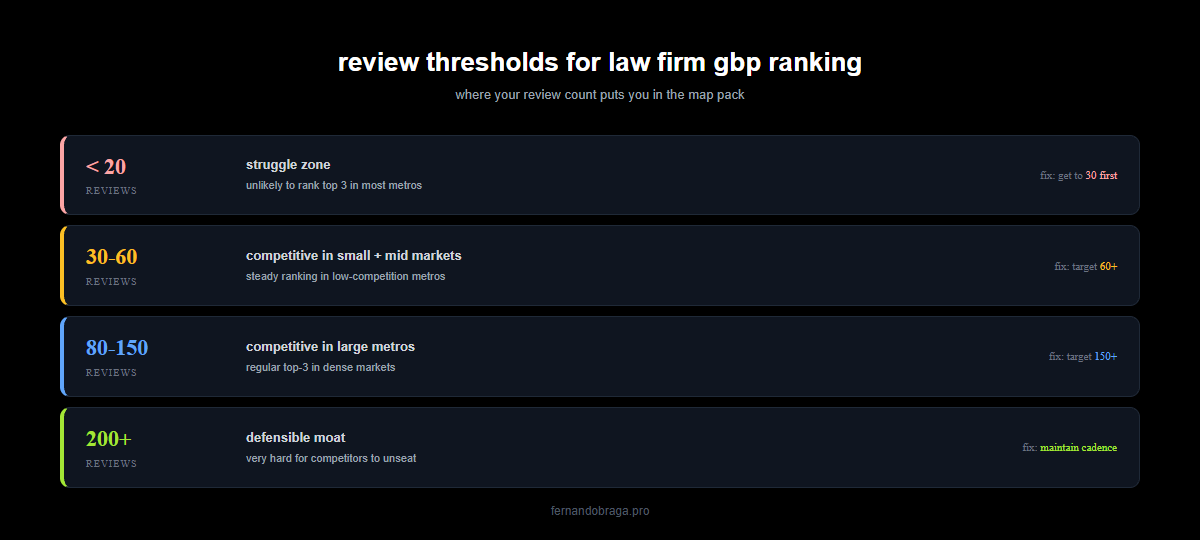
- under 20 reviews: struggle to rank top 3 in most metros
- 30-60 reviews: competitive in small and mid markets
- 80-150 reviews: competitive in large metros
- 200+ reviews: strong moat, very hard for competitors to unseat
multi-location and multi-attorney firms
if your firm has multiple offices or practitioners, handle gbp with care.
multi-location firms: each office gets its own gbp listing with its own address, phone, and hours. they share the firm brand but rank independently. duplicate or shared listings get suppressed by google.
solo attorneys vs firm listing: in most states, a solo attorney can have a personal gbp at their office and a firm gbp at the same address. some states restrict this. check your bar association rules before creating a second listing.
practitioner-level listings: a firm with 8 attorneys should not create 8 separate gbp listings. that triggers google’s spam filters. one firm listing is correct.
the compliance constraints that shape everything
bar association rules vary by state but common themes:
- no “specialist” or “expert” claims unless you are board-certified in a state that recognizes that certification
- no guarantee of outcomes (“we will win your case” violates rules in every state)
- comparative claims need substantiation (“best lawyer in [city]” is typically prohibited)
- testimonials must include a disclaimer in some states (“every case is unique, results may vary”)
- before/after is not applicable the way it works for other businesses (cosmetic dermatology can show results, law cannot)
your gbp content has to work inside these rules. focus on what you can substantiate: years of practice, cases handled, bar memberships, board certifications (where they exist), published speaking or writing, pro bono work.
common mistakes i see on law firm profiles
1. wrong primary category. “law firm” when the firm is 80% divorce work. kills the specific-category ranking opportunity.
2. duplicate listings. old addresses, office moves, practitioner-created accounts. each dilutes review count and splits ranking signals.
3. no service descriptions. the services field is blank or has 3-word labels. google cannot match long-tail queries without descriptions.
4. photos from 2019. empty waiting rooms, outdated branding, discontinued staff. signals a dead or neglected practice.
5. zero response rate on reviews. google weighs responsiveness. profiles with 0% response rank below profiles with 80%+ all else equal.
6. q&a left to strangers. uncurated questions from random users with misinformed or competing answers.
7. no posts ever. signals an inactive practice. even monthly posts beat no posts.
the 60-day gbp turnaround for law firms
days 1-7: audit. claim and verify ownership of every listing (including old ones). fix primary and secondary categories. complete service descriptions. add 15-20 current photos.
days 8-21: seed q&a with 10 questions. set up review request system. start weekly posting discipline. get the first 3-5 new reviews.
days 22-45: add attributes. respond to every historical review that does not have a response. publish 6 posts. ask for 6 more reviews.
days 46-60: evaluate ranking movement. check which queries you are showing up for. adjust category or service descriptions based on what google is matching you to.
expect meaningful map pack movement by day 45 in most competitive metros. full compounding takes 4-6 months as reviews accumulate and post history builds.
when gbp alone is not enough
in ultra-competitive practice areas (personal injury in major metros, for example), gbp gets you into the top 10 but breaking into the top 3 also requires on-site seo, local citations, and backlinks. combine gbp work with website optimization for the multiplicative effect.
and for cases where you need leads now, google ads fills the gap while gbp and seo compound. many firms run both indefinitely because legal is one of the few verticals where ads pay back even at $100+ CPCs.
next step
if you want a specific read on where your firm’s gbp stands (category accuracy, review gap vs competitors, post cadence, service descriptions, citation cleanliness), start with a free audit. i pull your profile, compare against the top 3 firms in your market, and show you the 5 moves that close the gap fastest.