
most business owners running google ads focus on the wrong numbers. they check clicks, impressions, cost per click. but none of that tells you the one thing that actually matters: are you making more money than you’re spending?
that’s roi. return on investment. and if you’re not calculating it, you’re flying blind.
this guide breaks down the exact formula to calculate google ads roi for local service businesses, with a real example you can follow.
why roi matters more than clicks or impressions
clicks don’t pay your bills. impressions don’t book appointments.
a campaign with 500 clicks and zero clients is a waste of money. a campaign with 30 clicks and 5 new clients paying $2,000 each is a goldmine.
roi cuts through the noise. it answers one question: for every dollar you put in, how many dollars do you get back?
if you’re spending money on google ads, roi is the only metric that determines whether to keep going, scale up, or stop.
everything else is a supporting metric. useful for optimization, useless for decision-making on its own.
the roi formula for local service businesses
the basic roi formula is simple:
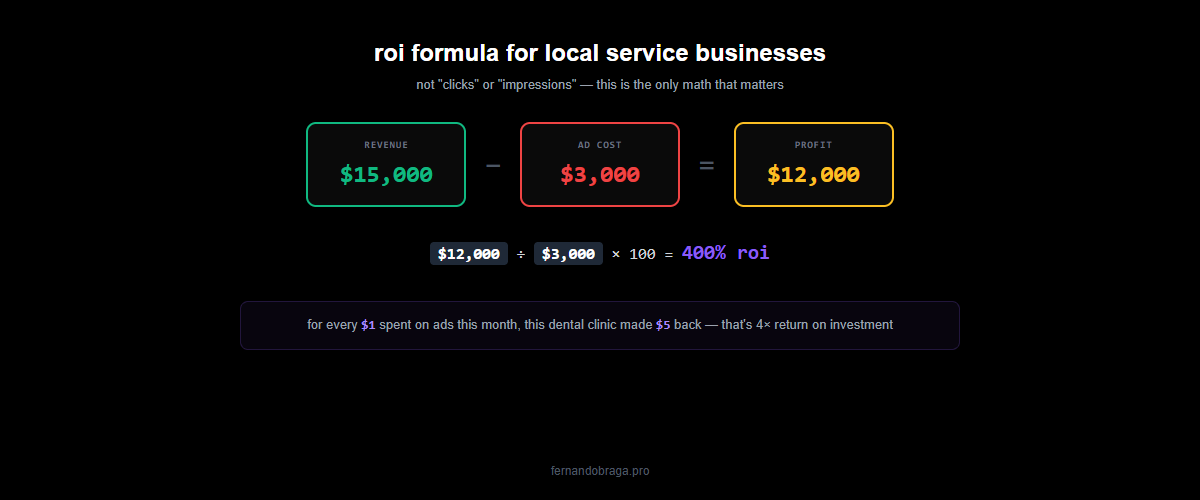
ROI = (revenue from ads – cost of ads) / cost of ads x 100
but to use it, you need three numbers specific to your business. let’s break each one down.
cost per lead
cost per lead (CPL) is how much you spend to get one potential client to contact you. a lead is a phone call, form submission, or whatsapp message that came from your ad.
formula: total ad spend / number of leads = cost per lead
example: you spent $1,500 on google ads last month and got 30 leads. your cost per lead is $50.
if you’re not tracking leads properly, you can’t calculate this. and without this number, everything else falls apart. set up conversion tracking before you worry about roi.
lead-to-client conversion rate
not every lead becomes a client. some don’t answer the phone. some are price shopping. some aren’t a good fit.
lead-to-client conversion rate tells you what percentage of leads actually become paying clients.
formula: number of new clients / number of leads x 100 = conversion rate
for most local service businesses, a healthy conversion rate is between 20% and 40%. if yours is below 15%, the problem might not be your ads. it might be your sales process.
average client lifetime value
client lifetime value (CLV) is the total revenue one client generates over the entire relationship, not just the first appointment.
a dentist might charge $200 for a first visit. but if that patient comes back twice a year for 5 years, their lifetime value is $2,000.
this is the number most business owners underestimate. and it’s the number that makes google ads roi look completely different when you calculate it correctly.
formula: average transaction value x number of transactions per year x average years as client = CLV
a real-world roi calculation (example)
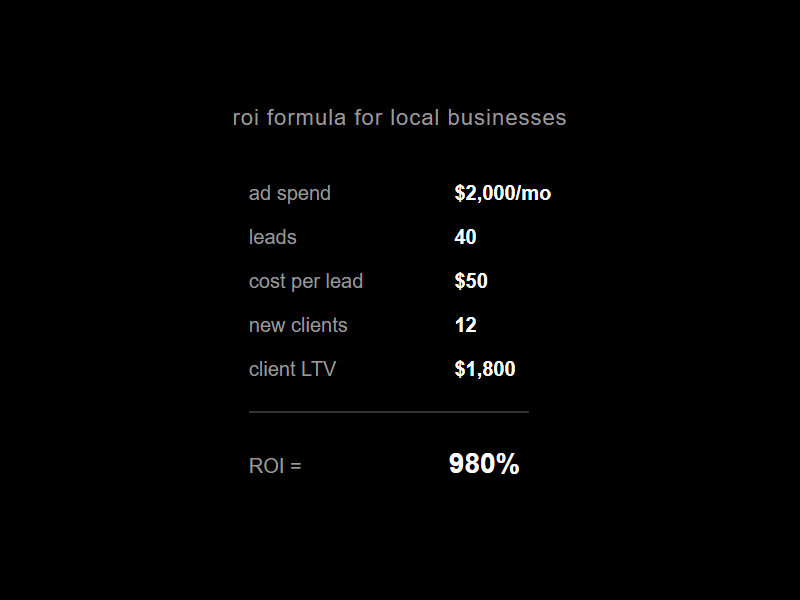
let’s run a complete example for a local dental clinic.
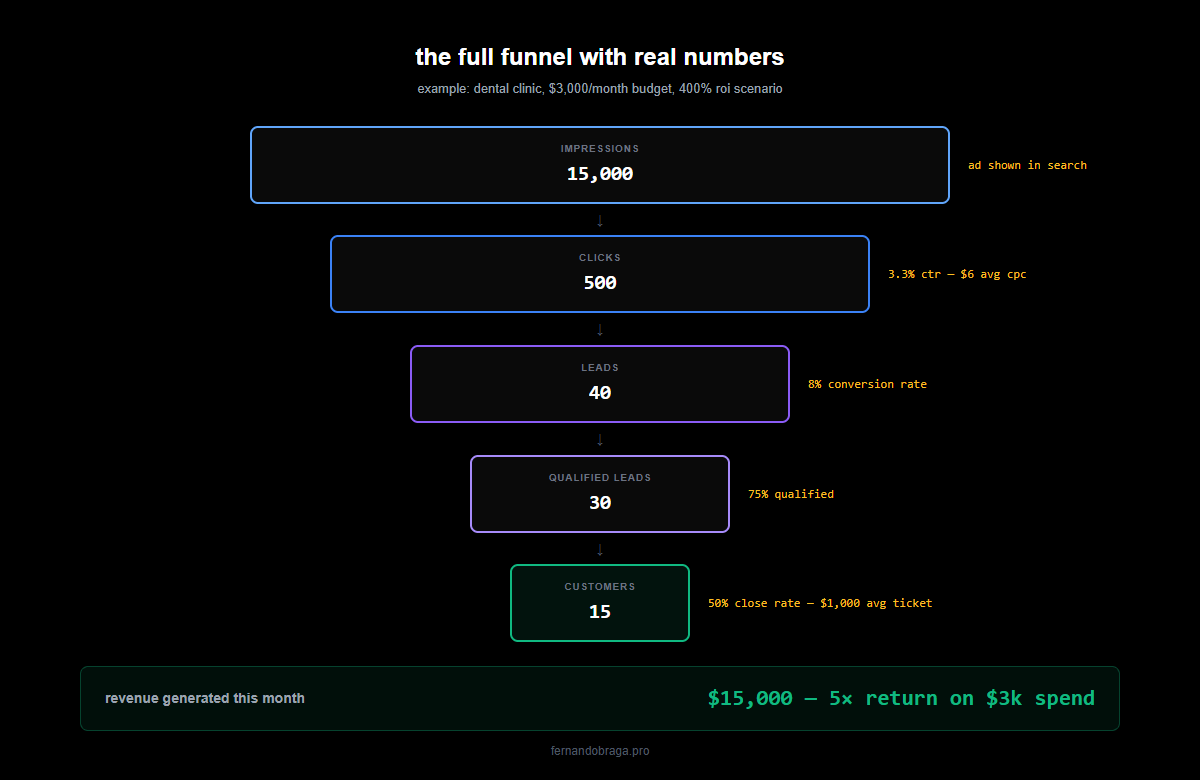
the numbers:
- monthly google ads spend: $2,000
- leads generated: 40
- cost per lead: $50
- lead-to-client conversion rate: 30%
- new clients from ads: 12
- average client lifetime value: $1,800
the calculation:
- revenue from ads: 12 clients x $1,800 = $21,600
- cost of ads (monthly): $2,000
- ROI = ($21,600 – $2,000) / $2,000 x 100 = 980%
for every $1 spent, this clinic gets $10.80 back. that’s a strong roi, and it’s realistic for local service businesses with good lifetime value.
important: this roi is calculated on lifetime value, not first-visit revenue. if you only count the first visit ($200 x 12 = $2,400), your roi looks like 20%. both numbers are correct, but they measure different things. the lifetime calculation shows the true business impact.
what roi to expect in your first 3 months
google ads is not a slot machine. you don’t put money in and get results on day one.
month 1: data collection. google’s algorithm is learning who clicks, who converts, what works. expect higher costs and lower roi. this is normal.
month 2: optimization kicks in. you have data to cut bad keywords, adjust bids, improve ad copy. costs should start dropping.
month 3: clearer picture. by now you should see a pattern. if roi is positive and improving, you have a winner. if it’s still negative with no trend upward, something needs to change.
realistic first-month roi for local businesses: break-even to slightly negative. by month 3, you should be seeing 200-400% roi if the campaign is well-managed and your business has solid fundamentals.
for context on typical costs, see my breakdown of how much google ads costs for local businesses.
why some businesses see great roi and others don’t
same platform, same type of ads, completely different results. here’s what separates the winners.
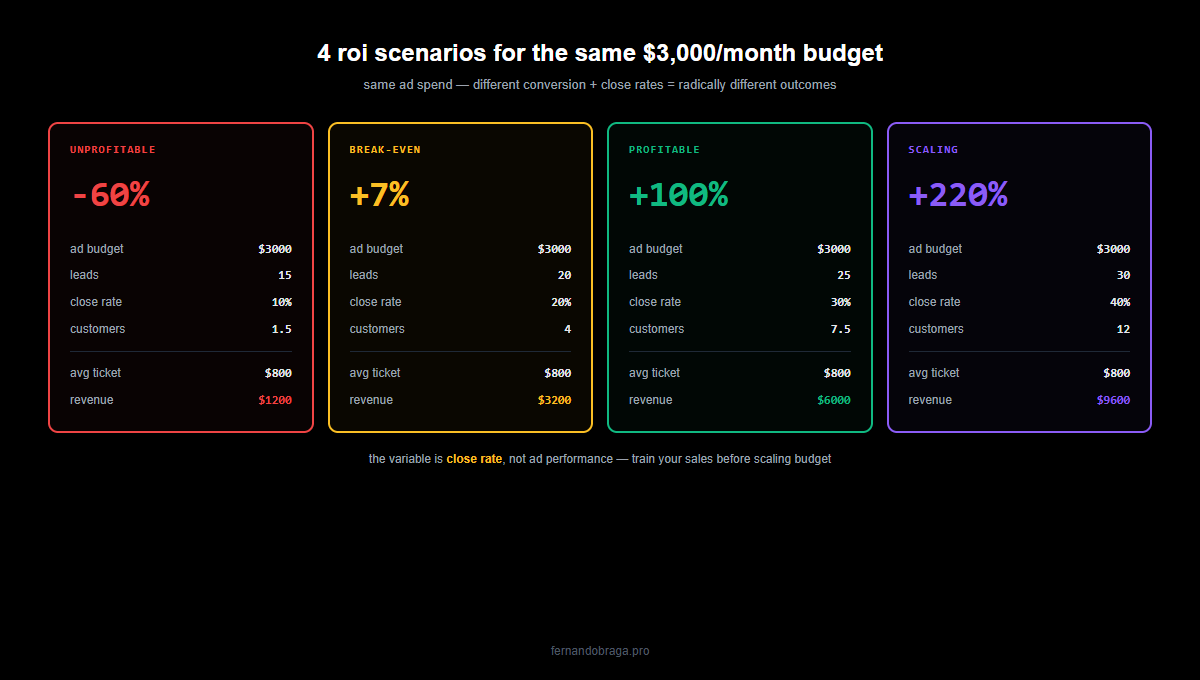
high roi businesses typically have:
- high client lifetime value (recurring services, not one-time jobs)
- fast follow-up on leads (calling back within 5 minutes, not 5 hours)
- proper conversion tracking set up from day one
- a website that builds trust and makes it easy to contact them
- realistic expectations about the learning phase
low roi businesses typically have:
- low-ticket services with no repeat business
- slow or no follow-up on leads
- no tracking, so they can’t even measure roi
- a website that looks outdated or loads slowly
- they quit after 2 weeks because “it’s not working”
the difference is rarely the ads themselves. it’s what happens before and after the click.
how to improve your google ads roi
if your roi isn’t where you want it, focus on these levers in order:
1. fix your tracking first. you can’t improve what you can’t measure. make sure every lead source is tracked.
2. reduce wasted spend. check your search terms report weekly. add negative keywords for irrelevant searches. this alone can improve roi by 20-30%.
3. improve your landing page. a better page means more leads from the same traffic. faster load time, clear call to action, trust signals like reviews and credentials.
4. speed up lead follow-up. the business that calls back first wins the client. if you’re taking hours to respond, you’re losing deals you already paid for.
5. increase client lifetime value. this isn’t an ads tactic, but it’s the most powerful roi lever. retention programs, follow-up sequences, and excellent service turn one-time clients into long-term revenue.
i’ve seen these principles work across different industries. my car dealership case study shows what happens when tracking, landing pages, and follow-up all work together.
when google ads isn’t the right investment
google ads works well for most local service businesses. but not all.
it’s probably not right for you if:
- your average transaction value is under $50 with no repeat business
- you can’t handle more clients right now (capacity issues)
- you have zero online presence (no website, no reviews)
- you’re not willing to invest at least 3 months to see real results
in these cases, other channels might give you better returns. organic seo, google business profile optimization, or referral programs could be more cost-effective starting points.
not sure if google ads makes sense for your business? request a free audit and i’ll look at your numbers together. no guesswork, just data.