
google reviews are one of the most powerful tools a local business has. they influence whether someone clicks on your listing, calls your office, or chooses a competitor instead. and yet, most businesses leave their review strategy to chance.
this guide gives you a simple, repeatable system to get more google reviews consistently. no tricks, no gimmicks. just a process that works.
why google reviews matter more than you think
when someone searches for a service in their area, google shows a map pack with three businesses. the first thing people notice? the star rating and how many reviews each business has.
here’s what the data shows:
- 93% of consumers say online reviews influence their purchasing decisions
- businesses with 4.0+ stars get significantly more clicks than those below
- google uses review signals (quantity, velocity, diversity) as a ranking factor for local search
reviews build trust before a potential client ever speaks to you. a business with 150 reviews and a 4.8 rating will almost always win over one with 12 reviews and a 5.0 rating. volume matters.
if your google business profile is complete but you have few reviews, you’re leaving money on the table.
the simple system for getting reviews consistently
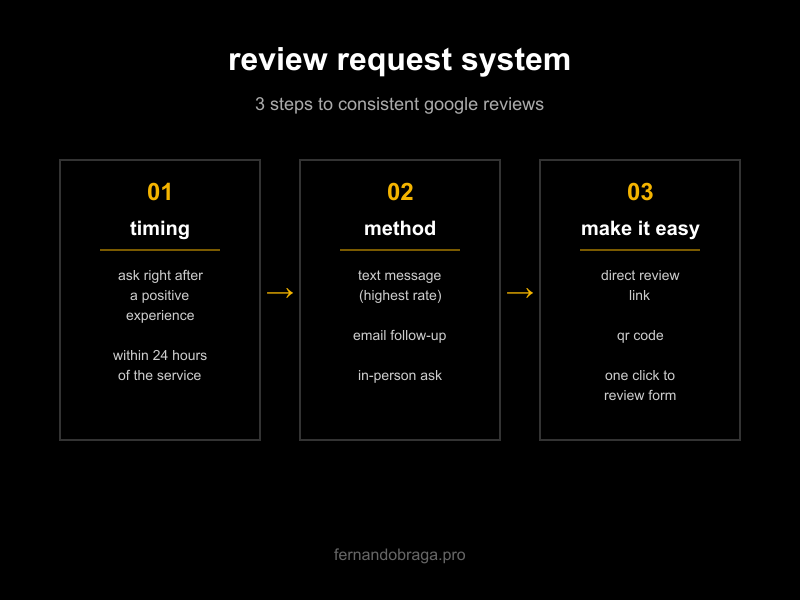
getting reviews isn’t about sending one mass email and hoping for the best. it’s about building a habit into your workflow. here’s the system.
timing. when to ask
the best time to ask for a review is right after a positive experience. the client is happy, the result is fresh, and they’re most willing to help.
good moments to ask:
- right after completing a service or appointment
- when a client gives you a verbal compliment
- after resolving a problem successfully
- at a follow-up appointment when results are visible
bad moments to ask:
- before the service is completed
- when a client seems rushed or distracted
- during a complaint or issue resolution (wait until it’s resolved)
the key is recognizing the “peak moment” of satisfaction and acting on it within 24 hours.
method. how to ask (text, email, in-person)
different clients respond to different channels. use the one that fits your relationship with them.
text message (highest conversion rate). send a short, personal message with your review link. keep it under 3 sentences. example: “hi [name], thanks for coming in today. if you have a minute, a google review would really help us out: [link]”
email. works well for clients you communicate with via email already. include the review link prominently. don’t bury it at the bottom of a long message.
in-person. simply ask. “would you mind leaving us a google review? it really helps other people find us.” then follow up with a text or email containing the link.
the most effective approach: ask in person, then send the link via text within 5 minutes.
making it easy. direct review links
every extra click reduces the chance someone will leave a review. use a direct review link that opens the review form immediately.
how to get your direct review link:
- go to your google business profile
- click “ask for reviews” (or search your business name on google and click “ask for reviews” in the business panel)
- copy the link google provides
make this link accessible everywhere:
- save it as a short url or qr code
- add it to your email signature
- print it on a card you hand to clients
- include it in post-service follow-up messages
the fewer steps between your request and the review form, the more reviews you’ll get.
how to respond to reviews (positive and negative)
responding to reviews matters almost as much as getting them. google values engagement, and potential clients read your responses to judge how you treat people.
for positive reviews:
- thank the reviewer by name
- mention something specific about their visit or service
- keep it genuine and short (2-3 sentences)
example: “thanks, maria. glad the cleaning went well. see you at your next appointment.”
for negative reviews:
- respond within 24 hours
- stay professional. never argue or get defensive
- acknowledge the issue and offer to resolve it offline
- provide a phone number or email for direct contact
example: “we’re sorry your experience didn’t meet expectations. please call us at [number] so we can make it right.”
a well-handled negative review can actually build trust. potential clients see that you care enough to respond and fix problems.
what not to do (google’s review policies)
google has clear policies about reviews. violating them can get reviews removed or your profile suspended.
don’t:
- offer incentives for reviews (discounts, gifts, free services)
- ask employees or friends to leave fake reviews
- use review gating (only directing happy clients to google)
- buy reviews from third-party services
- copy/paste the same response to every review
- ask for reviews in bulk from clients you served months ago
google’s algorithms detect patterns. a sudden spike of 20 reviews in one week after months of nothing looks suspicious and can trigger a review audit.
the safest approach: ask every client, one at a time, close to when the service happened. consistency over volume spikes.
how reviews impact your local search rankings
google’s local search algorithm uses three main factors: relevance, distance, and prominence. reviews directly affect prominence.
the review signals google considers:
- quantity. more reviews signal a more established, trusted business
- velocity. steady, ongoing reviews matter more than a burst followed by silence
- rating. higher average ratings help, but 4.5-4.9 is the sweet spot (a perfect 5.0 with few reviews looks less credible)
- keywords in reviews. when clients mention specific services in their reviews, it reinforces your relevance for those terms
- recency. recent reviews carry more weight than old ones
this is why the system matters. a steady flow of 2-4 reviews per week will outperform 50 reviews gathered in one campaign a year ago.
reviews also increase your click-through rate from search results. more clicks signal to google that your listing is relevant, which further improves rankings. it’s a compounding effect.
tracking your review growth
what gets measured gets managed. track these numbers monthly:
- total review count. your cumulative number
- new reviews this month. aim for consistent growth
- average rating. watch for trends (up or down)
- response rate. you should be responding to 100% of reviews
- review sources. are most coming from text requests, email, or organic?
check your google business profile insights to see how reviews correlate with calls, direction requests, and website clicks. in most cases, you’ll see a direct connection between review growth and lead volume.
set a realistic target. if you’re getting 2 reviews per month now, aim for 4 next month. small, consistent improvements beat ambitious goals that fizzle out.
create a simple spreadsheet or use a notes app to log your numbers on the first of each month. after 3 months, you’ll have enough data to see patterns. which request method gets the best results? is there a day of the week when clients are more likely to leave reviews? these insights help you refine your system over time.
if you’re using google business profile insights, pay attention to the “searches” and “views” metrics alongside your review count. businesses that actively manage their reviews typically see increases in all three areas. the correlation between review activity and profile visibility is well documented.
want to know how your review profile stacks up against competitors? request a free audit and i’ll show you exactly where you stand and what to improve.