
you’ve probably heard that citations are important for local seo. maybe someone told you to submit your business to 50 directories. maybe a service offered to build 200 citations for $99.
in 2026, the role of citations has changed. they’re not the ranking powerhouse they were in 2015. but they’re not irrelevant either. the question isn’t whether citations matter. it’s which ones matter and how much effort they deserve.
this guide breaks down what local citations actually are, which ones are worth building, and how to avoid the most common mistake that hurts more than it helps.
what local citations are (and what they aren’t)
a local citation is any online mention of your business name, address, and phone number (NAP). that’s it. it’s not a backlink. it’s not a review. it’s a mention of your business info on another website.
the idea behind citations is simple. the more places google finds consistent information about your business, the more confident it becomes that your business is real, located where you say it is, and offering the services you claim.
citations used to be one of the top ranking factors for the map pack. businesses would submit to hundreds of directories hoping each one would push them higher. that approach doesn’t work anymore. google has gotten better at verifying business information through other signals. but citations still play a foundational role in establishing your online presence.
what citations are not: they’re not a substitute for on-page seo, content, or reviews. they’re a baseline. you need them correct and consistent, but piling up more won’t move the needle like it used to.
the two types of citations
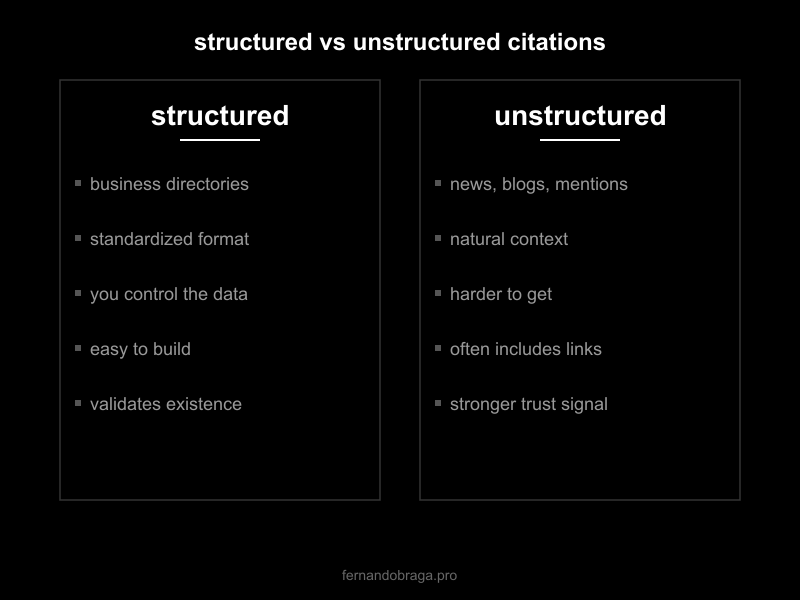
structured citations (directories)
structured citations are listings on business directories where your information appears in a standardized format. think google business profile, yelp, facebook, bing places, apple maps, and industry-specific directories.
these are the citations you have the most control over. you create a profile, fill in your NAP, add categories, upload photos, and publish. the data is organized in fields that search engines can easily parse.
structured citations matter because:
- they validate your existence. google cross-references your information across platforms. consistent data across major directories confirms you’re a legitimate business.
- they provide discovery channels. people actually search on yelp, apple maps, and industry directories. your listing there can generate direct traffic and calls.
- they anchor your local seo foundation. before you can rank in the map pack, google needs to trust your basic business information. structured citations establish that trust.
unstructured citations (mentions)
unstructured citations are mentions of your business on websites that aren’t directories. a local news article mentioning your business. a blog post listing recommended dentists in your city. a chamber of commerce page. a sponsorship mention on an event website.
these are harder to get but often more valuable because:
- they come from contextually relevant sources.
- they often include a link (which adds link authority).
- they signal to google that your business is active and recognized in your community.
unstructured citations are closer to what i’d call “digital PR” than traditional citation building. you earn them through community involvement, partnerships, and creating something worth mentioning.
do citations still impact rankings in 2026
yes, but less than they used to. here’s the honest breakdown.
in the early days of local seo, citations were a top-3 ranking factor. businesses that had more directory listings tended to rank higher. the logic was volume: more citations meant more trust signals.
today, google’s local algorithm weighs other factors more heavily:
- google business profile signals (categories, reviews, completeness, activity).
- on-page signals (relevant content, NAP on your website, location pages).
- review signals (quantity, velocity, diversity, and response rate).
- link signals (quality backlinks from relevant local sources).
- behavioral signals (click-through rates, calls, direction requests).
citations now function as a foundational factor. having your NAP correct on the major platforms is essential. but adding your business to 200 low-quality directories won’t improve your rankings. what matters is accuracy across the platforms that google actually checks.
think of it this way: citations are like having a valid business license. you need one to operate, but having 50 copies of the same license doesn’t make your business more legitimate.
the citations that actually matter
not all directories carry equal weight. here are the ones worth your time.
tier 1: essential for every local business
- google business profile (the most important one by far)
- apple maps / apple business connect
- bing places
- yelp
- facebook business page
tier 2: important for most businesses
- better business bureau (BBB)
- yellowpages.com
- foursquare / swarm
- local chamber of commerce
- mapquest
tier 3: nice to have
- industry-specific review sites
- local business associations
- data aggregators (data axle, neustar localeze, foursquare)
top directories by industry
beyond the general directories, certain industries have platforms that carry real weight:
- healthcare: healthgrades, zocdoc, vitals, webmd
- legal: avvo, findlaw, justia, martindale-hubbell
- home services: angi, homeadvisor, houzz, thumbtack
- restaurants: tripadvisor, opentable, doordash, grubhub
- automotive: carfax, autotrader, cars.com
if your business is in one of these verticals, the industry directories matter as much as the general ones. patients search on healthgrades. homeowners search on houzz. your listing there isn’t just a citation. it’s a discovery channel.
how to audit your existing citations
before building new citations, check what’s already out there. you might have listings you forgot about, duplicate profiles, or inconsistent information that’s actively hurting your local seo.
here’s a practical audit process:
- search your business name + city. go through the first 5 pages of google results. note every directory listing you find.
- check NAP consistency. for each listing, verify that the business name, address, and phone number match exactly what’s on your google business profile and your website.
- look for duplicates. some directories create listings automatically from data aggregators. you might have two or three yelp listings or multiple facebook pages.
- claim unclaimed listings. if a directory created a listing for you, claim it so you can control the information.
- update or remove outdated listings. old addresses, old phone numbers, or closed locations create conflicting signals that confuse google.
free tools like the moz local check or brightlocal’s citation tracker can speed this up. but a manual search catches things automated tools miss, especially unstructured citations.
if you’d rather have someone audit your citations and overall local presence, you can request a free audit here.
nap consistency. the #1 citation mistake
the single most damaging citation problem isn’t missing listings. it’s inconsistent information across your existing ones.
NAP stands for name, address, phone number. and “consistent” means exactly the same. not similar. not close enough. identical.
here’s what inconsistency looks like:
- “dr. smith dental” on google vs “smith dental clinic” on yelp vs “dr. john smith, dds” on healthgrades.
- “123 main street, suite 4” on your website vs “123 main st #4” on bing places.
- an old phone number still live on yellowpages from 3 years ago.
each inconsistency is a signal to google that says “i’m not sure this is the same business.” enough of these signals, and google’s confidence in your location data drops. that directly affects your map pack visibility.
the fix: pick one version of your NAP and use it everywhere. character for character. then go through every listing and update anything that doesn’t match. this is tedious work, but it’s some of the highest-impact local seo work you can do.
this ties directly into the local seo checklist. consistent NAP is one of the first items to lock down before anything else.
a practical citation building plan
you don’t need to submit to 200 directories in a week. here’s a realistic plan that covers what matters without wasting time on what doesn’t.
week 1: the essentials
- claim and fully optimize your google business profile.
- set up apple business connect.
- claim bing places.
- claim or create your yelp listing.
- set up your facebook business page.
week 2: tier 2 and industry directories
- submit to 3-5 industry-specific directories relevant to your business.
- submit to your local chamber of commerce.
- claim yellowpages and BBB listings.
week 3: data aggregators
- submit to the major data aggregators (data axle, neustar localeze, foursquare). these feed information to hundreds of smaller directories automatically.
ongoing: unstructured citations
- sponsor local events and ensure your business is mentioned on the event website.
- join local business associations that list members online.
- pitch local news outlets or bloggers when you have something newsworthy.
- get listed on your city or neighborhood’s community pages.
the key is quality and accuracy over quantity. ten perfect listings on authoritative platforms beat 200 listings on sites nobody visits.
citations are one piece of a larger local seo strategy. if you want to see how your citations, on-page seo, and google business profile all work together, request a free audit and i’ll break down exactly where your business stands.