clinics are harder to rank than most local businesses. the search terms are fragmented across specialties, trust signals matter more than in any other industry, and review dynamics get complicated by medical privacy rules. the good news: most clinics do local seo badly, so a moderate effort beats 80% of the competition in a 6-month window.
this is the playbook i use for dermatology, physical therapy, veterinary, aesthetic medicine, and multi-specialty medical clinics. the patterns repeat. the execution is what separates practices that fill their schedule from ones that stay half-booked.
what makes clinics different from other local businesses
three things that change how local seo works for medical practices.
trust is pre-clicked. a homeowner will call a random plumber. a patient will not call a random dermatologist. they read reviews, scan credentials, check if you take their insurance, look at your office photos, often compare 4-6 options before they book. your ranking gets you seen. your trust signals win the click.
search fragments across specialties. a general dentist has maybe 15 core keywords worth optimizing. a multi-specialty clinic can have 80+ meaningful queries, each with its own intent. “botox near me” and “skin cancer screening” are two completely different searches with different patient types, different competitors, and different conversion economics.
review velocity is slower. patients are less likely to leave reviews than restaurant customers or home service clients. you have to work harder per review, and HIPAA rules (in the US) restrict how you respond. a clinic with 40 reviews is doing well. a clinic with 200 is exceptional.
step 1: map your service tree
before any ranking work, map out every service you offer and group it into three layers:
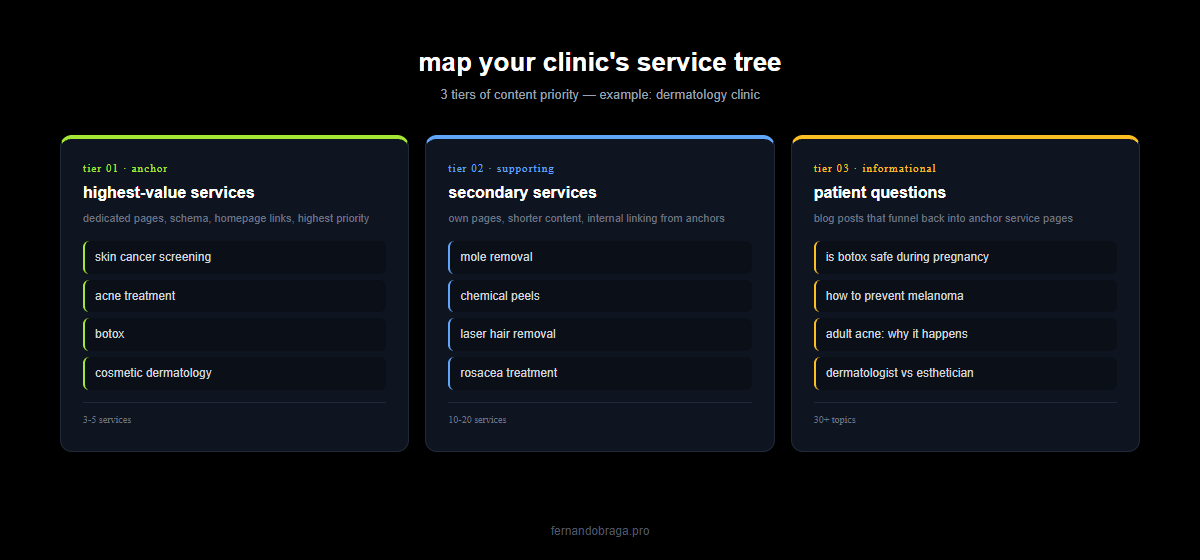
- anchor services: your 3-5 highest-volume or highest-value services. these get dedicated landing pages, internal linking from the homepage, schema markup, and top priority.
- supporting services: 10-20 services patients ask for but that do not drive most revenue. each gets a real page, not a bullet on a “services” dropdown.
- informational topics: questions patients search before booking anything (“is botox safe during pregnancy,” “how long does physical therapy take for a rotator cuff tear”). these become blog posts that funnel into anchor service pages.
for a dermatology clinic, anchor services might be: skin cancer screening, acne treatment, botox, cosmetic dermatology. supporting services: mole removal, psoriasis, rosacea, chemical peels, laser hair removal. informational: the 30+ questions patients ask before any of these.
this map becomes your content calendar for the next 12 months. without it, clinics spread their effort across too many low-intent topics and rank for nothing.
step 2: google business profile (still the biggest lever)
the playbook here is similar to any local business, but with clinic-specific nuance:
- primary category: the most specific one that describes your clinic. “dermatologist” not “medical clinic.” “physical therapy clinic” not “health consultant.” google ranks you for what your primary category signals.
- secondary categories: 3-5 that cover your real service mix. a dermatology clinic with aesthetic services adds “skin care clinic” and “medical spa.” a physio clinic adds “sports medicine clinic” and “rehabilitation center” if those apply.
- services field: list every procedure, each with its own 2-sentence description. this is a huge under-used feature that helps google match you to specific queries.
- photos: treatment rooms, equipment, waiting area, team members, building exterior. refresh monthly. clinics with 40+ photos outrank clinics with 5 in most metros.
- posts: 1-2 per week. new services, team updates, educational content. keeps the profile active and fresh in google’s eyes.
one clinic-specific thing: the “from the business” field matters more than most realize. write it as a patient-focused positioning statement, not as a generic about blurb. “we specialize in medical and cosmetic dermatology for adults and teens. same-week appointments for skin cancer screenings. accepting new patients with most major insurance plans.”
step 3: reviews (with HIPAA in mind)
clinics need to think about reviews differently than other businesses.
ask actively but compliantly. you can ask any patient to leave a review. you cannot disclose that someone is your patient in a public response. the safe response template: “thank you for your feedback. we take all reviews seriously and welcome the opportunity to speak with you directly.” never confirm or deny a relationship, never discuss specifics.
volume matters, but response rate matters more. google weighs how responsive a business is. a clinic with 60 reviews and an 85% response rate outranks a clinic with 120 reviews and a 20% response rate in most cases i have tracked.
target: 3-5 new reviews per month. that is slower than consumer businesses but realistic for clinics. use a post-visit text (compliant language, not revealing anything medical): “thanks for visiting today. if you had a positive experience, here is our review link: [url].” 8-12% conversion on that message is normal.
step 4: the website (service pages do the heavy lifting)
every anchor service needs its own page. not a line in a list. a full page with:
- 800+ words of content specific to that procedure: what it treats, who it is for, what the visit looks like, recovery or follow-up if applicable
- a patient-first tone. clinical accuracy matters, but jargon kills conversion. write like you are explaining the procedure to a smart friend
- trust signals inline: board certifications, training, years of experience with that procedure, insurance accepted, financing options
- real photos or diagrams where appropriate (clinic settings, equipment, not stock photos)
- internal links to related services and relevant blog posts
- a booking cta above the fold and after the main content
- schema markup: medicalbusiness or physician schema with the specific service
supporting services can have shorter pages (400-600 words) but still need to exist as their own URLs. “we also offer [x]” bullets on a catch-all page will not rank.
page speed matters. on mobile, under 2 seconds is the target. medical searches are emergency-tinged more often than people realize (“is this rash serious,” “my dog is vomiting”) and slow pages lose those searchers immediately.
step 5: local modifiers and neighborhood pages
for clinics in metro areas, create location-specific content:
- service + city pages: “dermatologist in [city],” “physical therapy in [city].” each unique, with local context (insurance accepted in that region, driving directions from landmarks, testimonials from patients in that area).
- service + neighborhood pages if your clinic draws from specific parts of a larger city. a clinic in midtown manhattan serves upper east side, chelsea, and lower manhattan differently. pages per neighborhood capture those searches.
- secondary clinic locations each get their own fully-built location page with NAP, hours, photos, services offered at that location, and team members who practice there.
avoid the common mistake of creating thin “locations” pages with 100 words each. google treats those as doorway pages and either ignores them or penalizes the whole site.
step 6: content that builds topical authority
informational blog content is slower to pay off but compounds. the clinics i have watched dominate their markets over 2-3 years all have 50+ deep informational articles tied to their service lines.
what works:
- patient questions as titles: “how long does it take to see results from botox,” “what is the difference between a dermatologist and an esthetician,” “can physical therapy help with sciatica”
- long-form answers (1,200-2,000 words) that actually answer the question in depth, not thin 300-word fluff
- author bylines with credentials — google’s e-e-a-t signals matter more in medical than in any other industry
- internal links from each article into the relevant anchor service page
- updated dates when content is refreshed, not left at 2021
publish monthly, minimum. clinics that publish weekly overtake competitors within 18 months in most metros.
the mistakes clinics make most often
1. one big services page. “we offer botox, fillers, skin care, laser, chemical peels” in a single page with a paragraph each. impossible to rank. split each into its own page.
2. blog posts that do not link back to services. a 2,000-word article on “what causes adult acne” with no link to the acne treatment service page wastes every visitor who arrived from google.
3. no schema markup. medicalbusiness, physician, and medicalprocedure schema tell google exactly what you are. most clinics have zero schema and rely entirely on content signals.
4. credentials hidden in an “about” page. board certifications, fellowships, training should be on every service page relevant to that credential. a dermatologist’s board certification belongs on the skin cancer page, not buried in a bio.
5. slow mobile site. clinics often run on outdated wordpress themes with 10+ plugins. 5+ second load times are common and kill both rankings and conversions.
the 6-month plan for a clinic starting from zero
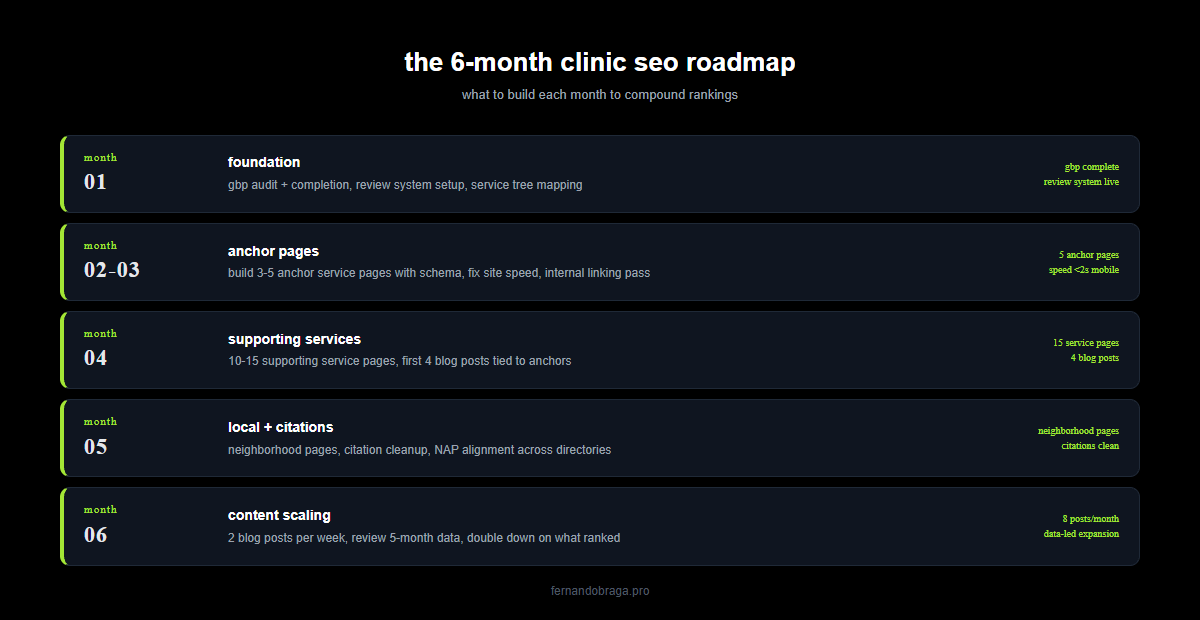
month 1: gbp audit and completion. review system setup. service tree mapping.
month 2-3: build anchor service pages (3-5). add schema. fix site speed. internal linking pass.
month 4: build supporting service pages (10-15). publish 4 blog posts tied to anchor services.
month 5: neighborhood pages if relevant. citation cleanup across directories (healthgrades, vitals, zocdoc, insurance directories).
month 6: content scaling. 2 blog posts per week. review the first 5 months of data, double down on what ranked.
expect meaningful movement in the map pack by month 3, consistent rankings by month 5-6, and continued compounding through year two.
when to add google ads
if you have capacity to fill now and organic will take months to catch up, google ads for your 3-5 anchor services fills the gap. once organic is ranking, ads can scale back or stay on for high-value cosmetic procedures where competition stays expensive indefinitely.
next step
if you want a specific read on where your clinic stands (gbp completeness, schema coverage, page speed, service page gaps, competitor comparison), start with a free audit. i pull the actual data and show you the 3 highest-leverage moves for your specific practice.