a dentist’s google business profile is worth more than the website. for most general dentistry and cosmetic searches, the map pack (3 local listings + map) eats 60-70% of clicks before anyone scrolls to organic results. if your gbp is weak, a new patient has already picked a competitor before loading your homepage.
this is the playbook for ranking a dental practice in the top 3 of the map pack. what google weighs, what it ignores, and the 60-day system that moves the needle in almost every market i have worked.
why dentists need gbp more than most businesses
three reasons dentistry is a gbp-dominant industry.
proximity is the strongest signal. dental patients pick by location first. a dentist 1.2 miles away beats a technically better dentist 4 miles away in most map pack results. you are not competing with every dentist in the city. you are competing with the 10 closest to each searcher’s zip code.
visual trust is everything. patients scan photos before reading anything. a clean, modern, well-lit operatory photo converts. a dim 2018 iphone shot of a waiting room kills conversion. dentistry is one of the few industries where photos directly drive call rates.
review velocity outpaces almost every other vertical. dentists see 20-40 patients a day. even at a 5% review conversion rate, a single practice can generate 50+ reviews a year. that volume compounds fast and creates strong moats against newer competitors.
the primary category choice
this is the single most consequential setting on your gbp. it controls which queries google considers you relevant for.
available options for dentists:
- dentist — default, works for most general practices
- dental clinic — preferred in markets where “clinic” is the common term (some states, international)
- cosmetic dentist — if 50%+ of your revenue is cosmetic procedures (whitening, veneers, smile makeover)
- pediatric dentist — if you exclusively or primarily see children
- orthodontist — if you are orthodontic-only or offering orthodontic services as primary
- oral surgeon — if surgical services are your main offering
- emergency dental service — if emergency care is a core service line
pick the most specific category that still represents the majority of your revenue. a cosmetic-focused practice using “dentist” as primary will rank below cosmetic-specific competitors for whitening and veneer searches. specificity wins.
one tip that changes things: if you do both general and cosmetic work, test primary as “dentist” with “cosmetic dentist” as secondary for 90 days, then test the reverse. track which combination drives more map pack impressions for your target queries. the answer varies by market.
the fields most dentists leave empty
services list with descriptions
gbp lets you list every service you offer, with a 2-3 sentence description for each. most dental profiles skip this or add bare labels.
what to list:
- all major procedures (cleanings, fillings, crowns, root canals, extractions, implants, invisalign, veneers, whitening)
- specialty services (sedation dentistry, pediatric, emergency, tmj treatment, sleep apnea appliances)
- cosmetic (smile makeover, bonding, gum contouring)
- insurance-related (in-network dentist, free exam for new patients, financing)
for each, write a 2-3 sentence description that mirrors how patients ask. for dental implants: “permanent tooth replacement using titanium posts integrated into the jawbone. suitable for single teeth or full-arch restoration. consultation includes 3d imaging and bone density assessment.”
this does two things: helps google match you to specific queries, and creates trust before the patient even clicks your website.
photos (the biggest visible leverage)
dentistry wins on photos more than any other local business. the target: 30+ photos, refreshed monthly.
what to include:
- exterior with signage and street view visible (helps with “dentist near me” matching)
- reception area (clean, modern, welcoming)
- operatories (2-3 different rooms, showing equipment and cleanliness)
- specific equipment (digital x-ray, intraoral cameras, cbct scanner, cerec machine)
- team photos (dentists in white coats, hygienists, front desk)
- before & after with patient consent (this is dental’s secret weapon — most industries cannot show outcomes)
- comfort amenities (noise-canceling headphones, blankets, tvs on ceilings, sedation setup)
one nuance specific to dentistry: waiting room photos with patients visible are a negative signal if the patients look unhappy or bored. either stage the shot with team members in the space or photograph it empty but styled.
attributes
enable every applicable attribute:
- accepts new patients
- free parking
- wheelchair accessible
- virtual consultations available
- online appointments
- languages spoken
- LGBTQ+ friendly (matters in some markets)
- accepts credit cards, care credit, payment plans
some of these directly filter who sees your profile. “dentist that accepts care credit” is a real filtered search in many US markets.
reviews: the ranking factor you control
for dentists, review volume and freshness are the two biggest ranking levers after primary category.
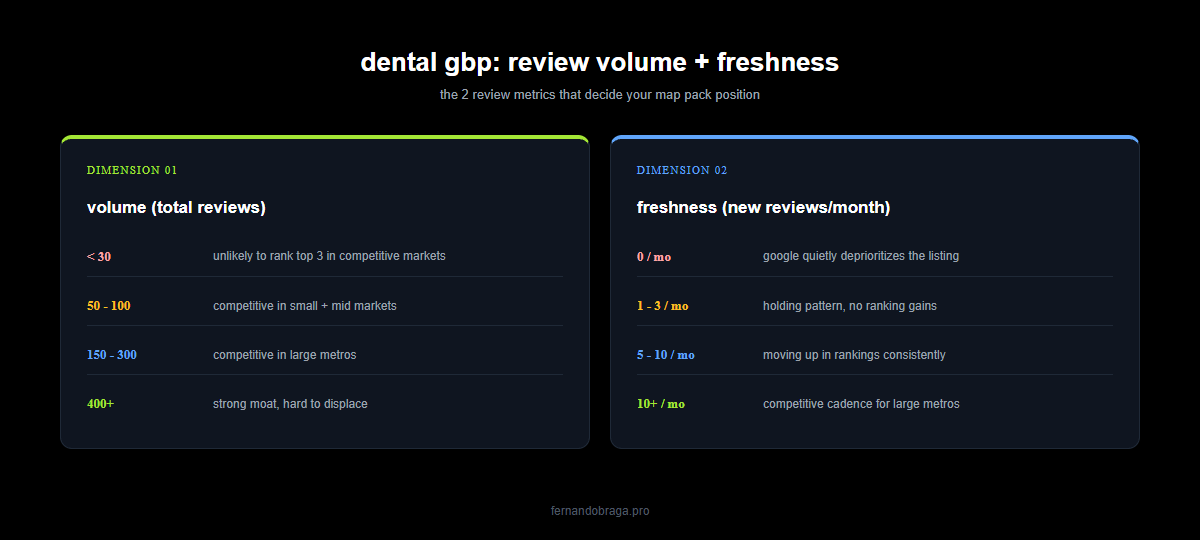
volume thresholds:
- under 30 reviews: unlikely to rank top 3 in any competitive market
- 50-100 reviews: competitive in small and mid markets
- 150-300 reviews: competitive in large metros
- 400+ reviews: strong moat, hard to displace
freshness thresholds:
- no reviews in 30+ days: google quietly deprioritizes
- 1-3 reviews/month: holding pattern
- 5-10 reviews/month: moving up in rankings
- 10+ reviews/month: competitive in most metros
the practical system:
- ask every adult patient at checkout. print a card with a QR code linking to your gbp review page. “if you had a good experience today, this takes 30 seconds to leave us a review.”
- send a follow-up text within 2 hours of the appointment. “hi [name], thanks for coming in. if your visit was great, would you mind sharing a quick review? [link]”
- respond to every review. positive ones get short personalized thanks using the patient’s first name. negative ones get measured, non-defensive responses that invite offline conversation. google tracks response rate.
- ask patients to mention what they came in for. organic keyword mentions in review text (“root canal,” “invisalign,” “dental implants”) help you rank for those specific procedures. do not tell them what to write. just nudge them to mention their procedure.
target: 8-12 new reviews per month minimum for competitive metros, 4-6 for smaller markets.
posts (the cadence signal)
gbp posts stay live for 7 days then archive. google does not care much about individual post content. what it cares about is whether your profile is actively updated.
publish 1-2 posts per week with rotating content:
- new service announcements
- team member introductions
- technology or equipment updates
- patient education (oral hygiene tips, myths about procedures)
- seasonal offers (back-to-school cleanings, year-end insurance reminders)
- holiday hours and special closures
keep posts short (150-300 words), add a photo, include a call-to-action button. the cadence alone moves rankings 10-20% in most markets over 3 months.
q&a: the sleeper field
most dental gbp profiles leave q&a empty or let random users populate it. big mistake.
seed 10-15 questions yourself and answer them. examples for a general practice:
- “do you accept [insurance]?”
- “how much does a cleaning cost without insurance?”
- “do you offer sedation dentistry?”
- “can i book an appointment for the same day?”
- “do you see children?”
- “what should i do in a dental emergency?”
- “do you offer payment plans?”
- “how often should i come in for a cleaning?”
each answer is public, becomes part of your profile, and helps you rank for long-tail queries that match the question text. it also answers common objections before the patient calls, which raises call-to-booking conversion.
multi-location practices
if you have multiple offices, each gets its own gbp listing with its own address, phone number, hours, and team-specific photos. they should not share photos or identical descriptions — google penalizes duplicate content across listings.
common mistakes i see:
- all locations using the same exterior photo (the main office)
- all locations with identical service descriptions copied from the flagship
- one practice trying to verify a second location without a real physical presence (gets flagged and suspended)
each location needs genuine unique content. the team at that specific office, their photos, their hours, any services unique to that location.
the common mistakes killing dental profiles
1. wrong primary category. “dentist” on a cosmetic-focused practice, “cosmetic dentist” on a general practice. misalignment caps your ranking ceiling.
2. duplicate listings. old addresses, former ownership, auto-created entries. each duplicate splits your signals and review count. audit monthly, merge or remove aggressively.
3. zero photos for 6+ months. signals an abandoned or inactive practice. refresh monthly at minimum.
4. no response to reviews. response rate is a ranking factor. aim for 100% response within 48 hours.
5. services section blank or unused. missing the single biggest opportunity for long-tail query matching.
6. hours inaccurate. google penalizes profiles where listed hours do not match google traffic data (it sees when your phone answers and when it does not). update for holidays every time.
7. review manipulation. obvious fake reviews (same accounts, similar text, burst patterns) can destroy a listing. google’s detection has gotten very good. do not do it.
the 60-day gbp system for dental practices
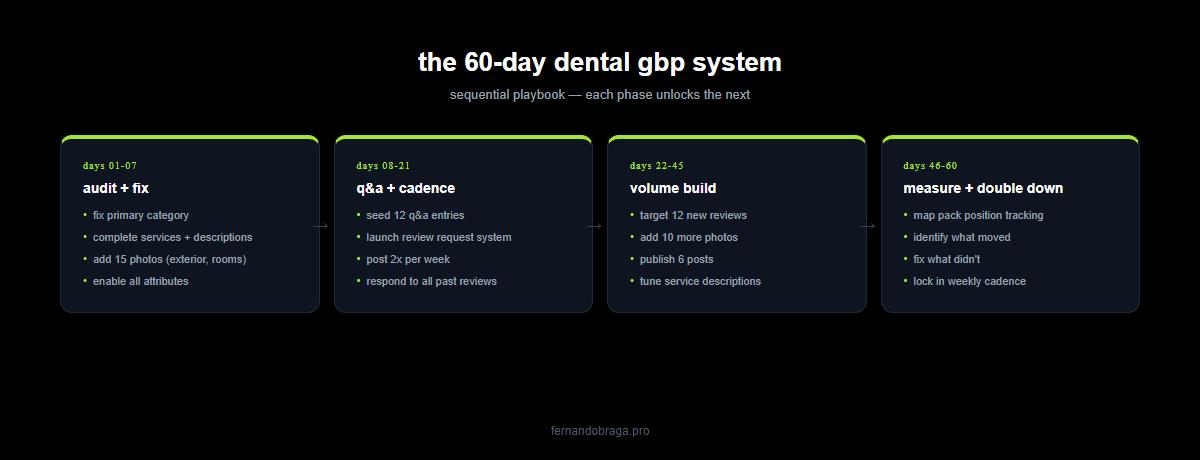
days 1-7: audit current listing. fix primary category. complete every field: services with descriptions, attributes, hours, payment methods. add 15 photos (exterior, reception, operatories, team).
days 8-21: seed q&a with 12 questions. set up the review request system (qr card, post-visit text). start posting twice per week. respond to all historical reviews that lack responses.
days 22-45: target 12 new reviews in this period. add 10 more photos (equipment, before/afters with consent). publish 6 posts. evaluate what is ranking and adjust service descriptions to match.
days 46-60: measure map pack positions across your 3-mile radius using a tool like local falcon or brightlocal. double down on whatever moved. address whatever did not.
expect map pack movement by day 30, consistent top-3 in low and mid-competition markets by day 60-90. large metros take 4-6 months for full compounding.
when gbp alone is not enough
in hyper-competitive metros (los angeles, nyc, chicago), gbp gets you into the top 5 but the top 3 require also optimizing the website, getting citations across dental directories, earning links from local publications. combine gbp with on-site work and the map pack position compounds.
for patients you need this quarter while gbp compounds, google ads for dentists fills the gap. both working together is the standard playbook for practices aiming for predictable patient flow.
next step
if you want a specific read on where your dental gbp stands (category, review gap vs closest 5 competitors, photo inventory, post cadence, service descriptions), start with a free audit. i pull the actual profile, compare it against your closest ranked competitors, and show you the 5 highest-leverage moves for the next 60 days.