
most clinics and medical practices depend on referrals. it works, but it’s inconsistent and hard to scale. google ads gives you a direct channel to patients who are actively searching for the services you offer, right when they need them.
unlike social media ads where you’re interrupting people, google ads captures intent. someone searching “dermatologist near me” or “orthopedic clinic in [city]” is ready to book an appointment. that’s why google ads consistently delivers the best return for healthcare practices.
this guide covers healthcare ad policies, campaign structure, keyword strategy, budgets, and how to measure your actual cost per patient. if you already run ads for a dental practice, you’ll notice similarities with my google ads guide for dentists, but clinics and medical practices have unique challenges worth addressing.
why google ads is the best channel for clinics
clinics operate in a space where patients make decisions based on urgency, proximity, and trust. google ads aligns perfectly with all three.
- high intent traffic. patients searching for medical services aren’t browsing for fun. they have a problem and want a solution. this makes conversion rates significantly higher than social media advertising.
- geographic precision. you can target your exact service area down to zip codes. no wasted spend on patients who live too far to visit your clinic.
- specialty targeting. unlike general marketing, you can run separate campaigns for each specialty your clinic offers. dermatology, cardiology, orthopedics, each with its own budget and keyword set.
- measurable results. every click, call, and form submission can be tracked back to the exact keyword and ad that generated it. this is critical for understanding your lead tracking setup.
if you’re evaluating whether to invest in ads or organic traffic first, my comparison of google ads management and seo can help you decide. for most clinics, running both simultaneously delivers the best results.
healthcare advertising policies you need to follow
google has strict policies for healthcare advertising. violating them means your ads get disapproved or your account gets suspended. here’s what matters most.
- no guarantees of outcomes. you cannot promise cures, specific results, or guaranteed recovery times. “we’ll fix your back pain” is a policy violation. “specialized back pain treatment” is fine.
- restricted content categories. some medical services require google certification before you can advertise. this includes addiction treatment, pharmaceuticals, and certain clinical procedures.
- landing page requirements. your landing page must clearly identify who you are, your qualifications, and how patients can contact you. no misleading claims, no fake testimonials.
- personalized advertising restrictions. you cannot use remarketing for certain healthcare categories. google restricts targeting based on medical conditions or health status.
- local regulations. depending on your country, additional rules apply. in brazil, for example, medical advertising must follow cfm (conselho federal de medicina) guidelines alongside google’s policies.
the safest approach: focus your ads on the services you offer and the credentials of your team. avoid making claims about results. let the patient decide based on facts.
campaign structure for medical practices
the biggest mistake clinics make is dumping everything into one campaign. a multi-specialty clinic running one campaign with generic keywords wastes money and makes optimization impossible.
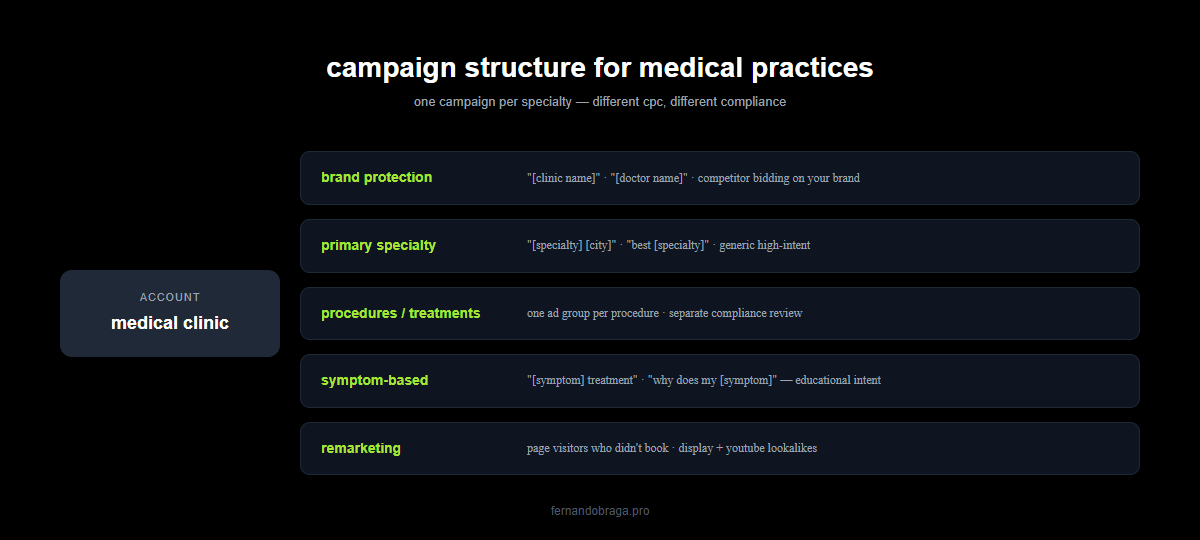
separating by specialty
each specialty your clinic offers should be its own campaign or, at minimum, its own ad group. here’s why:
- budget control. dermatology might have a higher patient lifetime value than general practice. separate campaigns let you allocate more budget to higher-value specialties.
- ad relevance. someone searching for a cardiologist doesn’t want to see a generic “medical clinic” ad. specialty-specific ads get higher click-through rates and lower costs per click.
- landing page alignment. each campaign should point to a specialty-specific landing page. a cardiology searcher should land on your cardiology page, not your homepage.
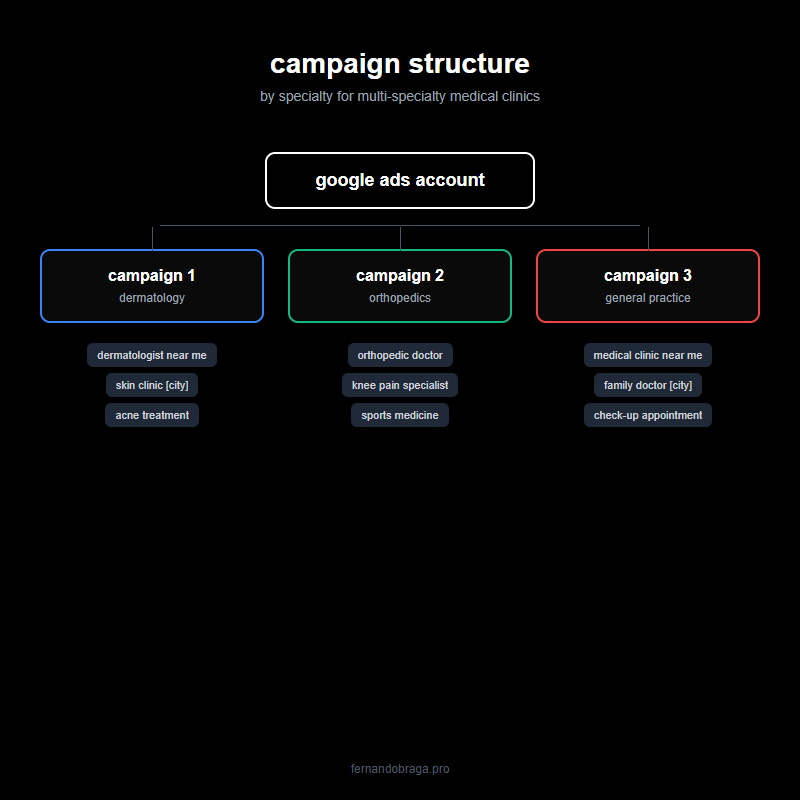
example structure for a multi-specialty clinic:
- campaign 1: dermatology (keywords: dermatologist near me, skin clinic [city], acne treatment [city])
- campaign 2: orthopedics (keywords: orthopedic doctor [city], knee pain specialist, sports medicine clinic)
- campaign 3: general practice (keywords: medical clinic near me, family doctor [city], check-up appointment)
this approach mirrors what works for dental practices but scaled across multiple service lines.
branded vs non-branded campaigns
branded campaigns target your clinic’s name. non-branded campaigns target general service terms. you need both.
branded campaigns protect your name from competitors bidding on it. they’re cheap (usually under $1 per click) and convert extremely well because the patient already knows you. if a competitor is bidding on your clinic name, you need a branded campaign immediately.
non-branded campaigns capture new patients who don’t know your clinic yet. these cost more but drive growth. “cardiologist in [city]” brings patients who are comparing options. your ad and landing page need to convince them you’re the best choice.
keep these in separate campaigns. branded campaigns will always have better metrics, and mixing them with non-branded skews your data.
emergency vs routine services
emergency medical searches behave differently from routine appointment searches:
- emergency searches (“urgent care near me”, “emergency clinic open now”) convert fast. these patients call immediately. your ads need call extensions and should run 24/7 if your clinic handles emergencies.
- routine searches (“annual check-up [city]”, “dermatologist appointment”) have a longer decision cycle. patients might compare 2 or 3 clinics before booking. your landing page needs to build trust quickly.
separate these into different campaigns because they need different bidding strategies, ad schedules, and budgets.
keyword strategy for clinics
keyword selection makes or breaks your campaigns. here’s how to approach it for medical practices.
start with exact and phrase match. broad match keywords in healthcare are dangerous. “back pain treatment” on broad match could trigger your ad for searches like “home remedies for back pain” or “back pain exercises youtube.” those searchers aren’t looking for a clinic.
use location modifiers. every non-branded keyword group should include location terms. “[specialty] in [city]”, “[specialty] near me”, “[specialty] [neighborhood]”. patients search locally, and location keywords have lower competition than generic terms.
build negative keyword lists aggressively. healthcare has a lot of informational searches. add negatives for: “free”, “home remedy”, “diy”, “youtube”, “reddit”, “salary”, “school”, “course”, “degree”. these filter out people researching careers or looking for free advice, not patients.
competitor keywords. bidding on competitor clinic names can work but it’s expensive and has lower conversion rates. test it with a small budget before committing. some clinics find it profitable, others don’t.
typical cpc ranges for medical keywords:
- general practice: $3 to $8 per click
- dermatology: $5 to $12 per click
- orthopedics: $6 to $15 per click
- cardiology: $8 to $20 per click
- urgent care: $10 to $25 per click
higher-value specialties cost more per click, but they also generate higher revenue per patient. focus on cost per patient acquired, not cost per click.
writing compliant ad copy that converts
healthcare ad copy needs to balance compliance with persuasion. here’s what works.
lead with credentials. “board-certified cardiologist” or “20+ years of experience” builds immediate trust. credentials matter more in healthcare than almost any other industry.
highlight convenience. “same-day appointments available”, “open saturdays”, “online booking”. patients choose convenience when credentials are similar between clinics.
use specific service names. “comprehensive skin cancer screening” performs better than “dermatology services.” specificity matches search intent more closely.
avoid prohibited language. never use “best doctor”, “guaranteed results”, “painless procedure”, or “cure.” google will disapprove these ads, and in some countries, medical boards will penalize you.
always include a call to action. “book your appointment”, “call now for availability”, “schedule a consultation.” tell the patient exactly what to do next.
for more on writing effective ads within google’s guidelines, my guide on tracking leads from google ads covers how to measure which ad variations actually generate appointments.
budget recommendations by practice size
your budget should match your practice size, market competition, and growth goals. here are realistic starting points.
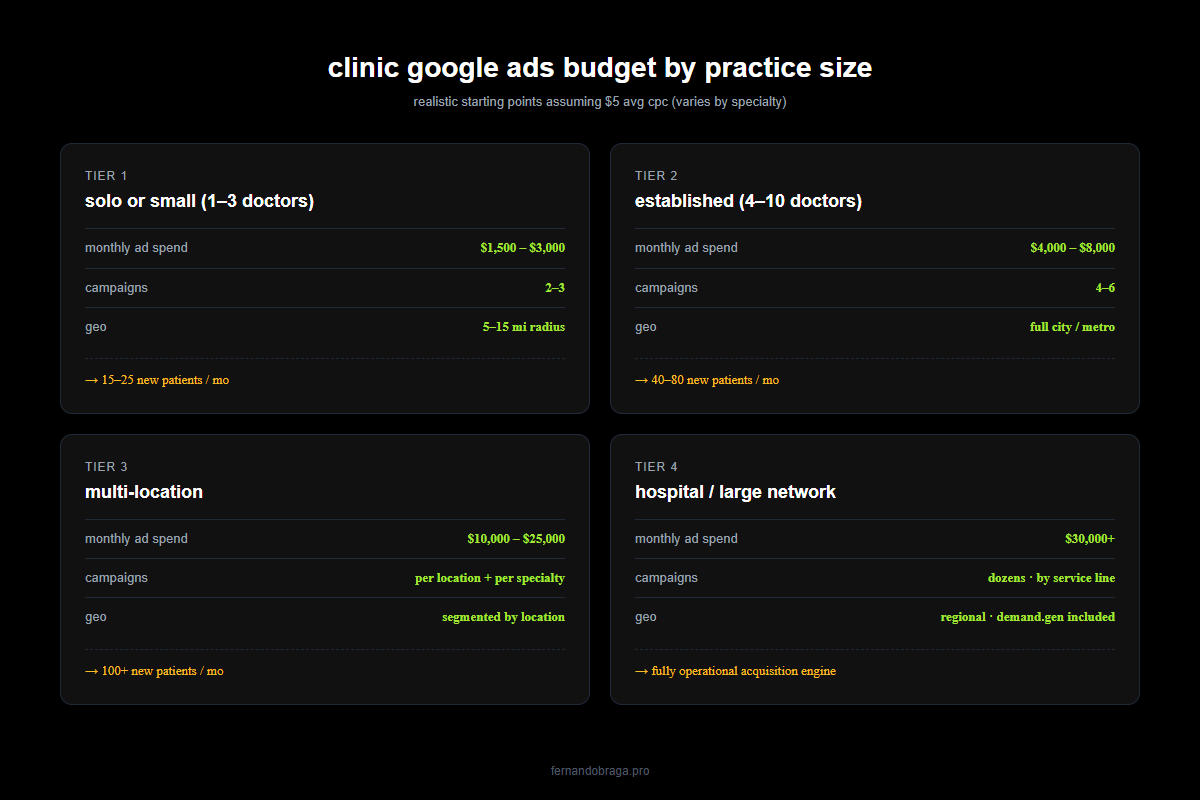
solo practitioner or small clinic (1 to 3 doctors):
- starting budget: $1,000 to $2,000/month
- focus on 1 to 2 core specialties
- run search campaigns only. skip display and performance max initially
mid-size clinic (4 to 10 doctors, multiple specialties):
- starting budget: $3,000 to $6,000/month
- run separate campaigns per specialty
- add branded campaigns to protect your clinic name
large practice or hospital group:
- starting budget: $8,000 to $15,000+/month
- full campaign structure across all specialties
- dedicated budget for high-value services (surgery, specialized treatments)
- consider performance max after search campaigns are profitable
start conservative. run for 60 to 90 days, collect conversion data, then scale the campaigns that deliver patients at a profitable cost. you can see real examples of this approach working in my medical clinic case study and dermatology clinic case study.
measuring patient acquisition cost
the most important metric for any clinic running google ads isn’t ctr (click-through rate) or cpc (cost per click). it’s cpa: cost per acquisition. in healthcare, that means cost per patient acquired.
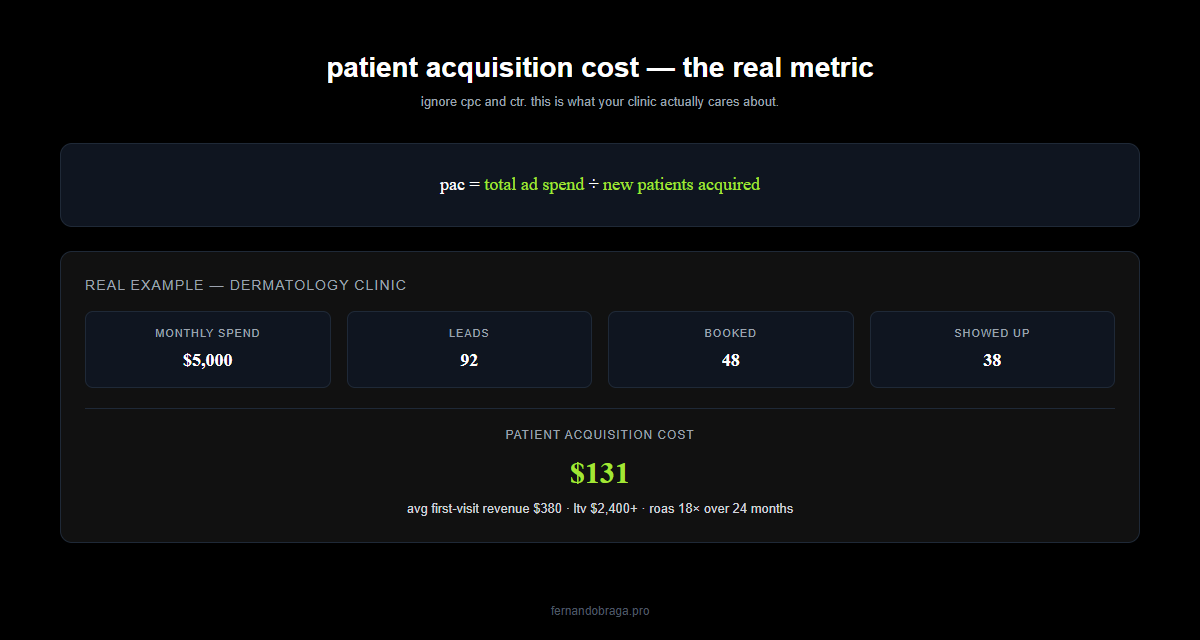
here’s how to calculate it:
cost per lead = total ad spend / total leads (calls + form submissions)
cost per patient = total ad spend / confirmed new patients from ads
example: you spend $3,000/month on google ads. you get 60 leads (calls and form submissions). 30 of those become actual patients. your cost per lead is $50. your cost per patient is $100.
is $100 per patient good? depends on your specialty:
- if the average patient generates $500 in revenue on the first visit and $2,000+ over their lifetime, $100 acquisition cost is excellent.
- if the average patient generates $80 for a single consultation with no follow-up, $100 acquisition cost is a problem.
to measure this accurately, you need proper conversion tracking. phone call tracking, form submission tracking, and ideally integration with your patient management system. my lead tracking guide walks through the complete setup.
review your cost per patient monthly. compare it across specialties. some campaigns will be highly profitable while others break even. shift budget from break-even campaigns to profitable ones.
if you want a professional assessment of your clinic’s advertising potential, request a free audit and i’ll analyze your current setup and identify opportunities.