
most local business owners put all their energy into their google business profile. that makes sense. it shows up in the map pack, it drives calls, and it’s free.
but here’s the thing: your website is the other half of the equation. google uses signals from your site to decide where you rank in local results. if your pages are poorly optimized, your gbp won’t perform at its full potential either.
this guide covers the on-page seo fundamentals that actually move the needle for local businesses. no fluff, no theory. just the things i set up for every client site i build.
why your website still matters for local rankings
google’s local algorithm uses three factors: relevance, distance, and prominence. your google business profile handles distance and some relevance. but prominence? that comes from your website.
prominence includes things like backlinks, reviews, and how well your site content matches what someone is searching for. a well-optimized website tells google exactly what you do, where you do it, and why you’re the best option in that area.
if you’re only focusing on your gbp and ignoring your site, you’re leaving rankings on the table.
title tags and meta descriptions for local businesses
title tags are the single most important on-page ranking factor. for local businesses, they need to include your service and your location. every page should have a unique title tag that tells both google and the searcher exactly what that page is about.
including city names naturally
don’t stuff your city name into every sentence. instead, include it once in the title tag, once in the h1, and naturally throughout the content. google is smart enough to understand context. writing “dentist in boca raton” once is better than repeating it eight times.
for businesses serving multiple cities, create dedicated service area pages. each page targets a different location with unique content. don’t just swap out the city name and call it a day. google treats that as thin, duplicate content.
service + location formula
the formula i use for every client title tag is simple:
[service] in [city] | [business name]
examples:
- teeth whitening in boca raton | smile dental clinic
- family law attorney in austin | johnson legal group
- ac repair in miami | cool breeze hvac
this format works because it puts the keyword first, includes the location, and brands the page. meta descriptions follow the same logic but focus on getting the click. include a benefit or differentiator. mention the location. keep it under 155 characters.
header structure and content organization
your page should have one h1 (your main keyword + location), followed by h2s for each major section, and h3s for subtopics. this hierarchy helps google understand your content structure.
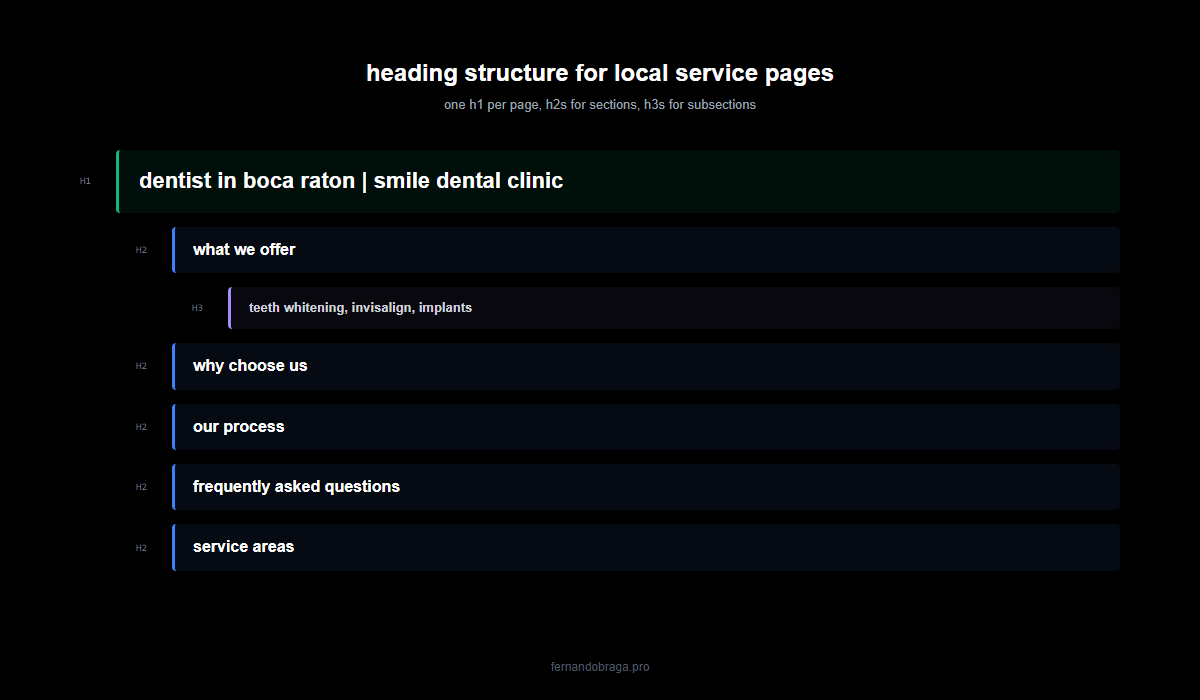
for a service page, a good structure looks like:
- h1: [service] in [city]
- h2: what we offer
- h2: why choose us
- h2: our process
- h2: frequently asked questions
- h2: service areas
each section should have real, useful content. not filler paragraphs. answer questions your customers actually ask. describe your process. explain what makes your approach different.
this structure also helps with featured snippets. google pulls answers from well-organized content, especially from pages with clear header hierarchies and concise paragraphs.
nap consistency (name, address, phone)
nap stands for name, address, and phone number. it needs to be exactly the same everywhere: your website, your google business profile, your social media profiles, and every directory listing.
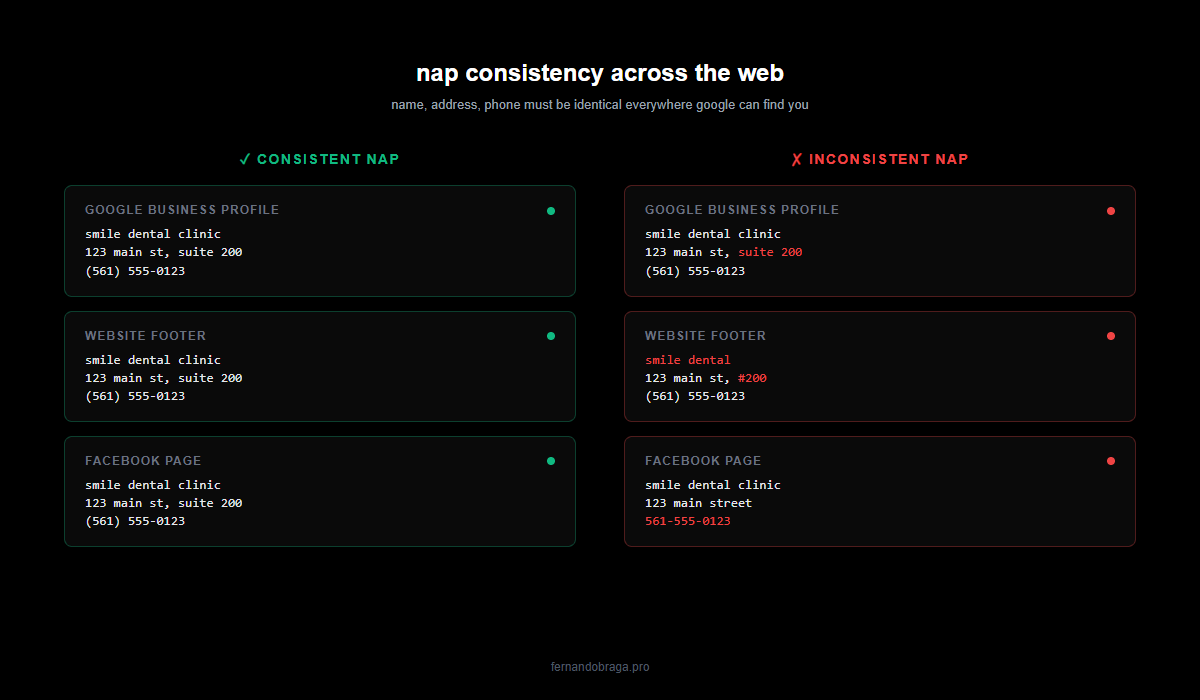
“exactly the same” means exactly the same. if your gbp says “123 main street, suite 200” then your website footer shouldn’t say “123 main st #200”. google treats inconsistencies as a trust signal. the more consistent your nap, the more confident google is that your business information is accurate.
put your nap in your website footer so it appears on every page. use plain text (not an image) so google can read it. if you have multiple locations, each location page should display only that location’s nap information.
this is one of the items on my complete local seo checklist that people skip most often, and it’s one of the easiest to fix.
schema markup for local businesses
schema markup is code you add to your website that helps search engines understand your content better. think of it as a label system. instead of google guessing that “555-123-4567” is a phone number, schema tells it directly.
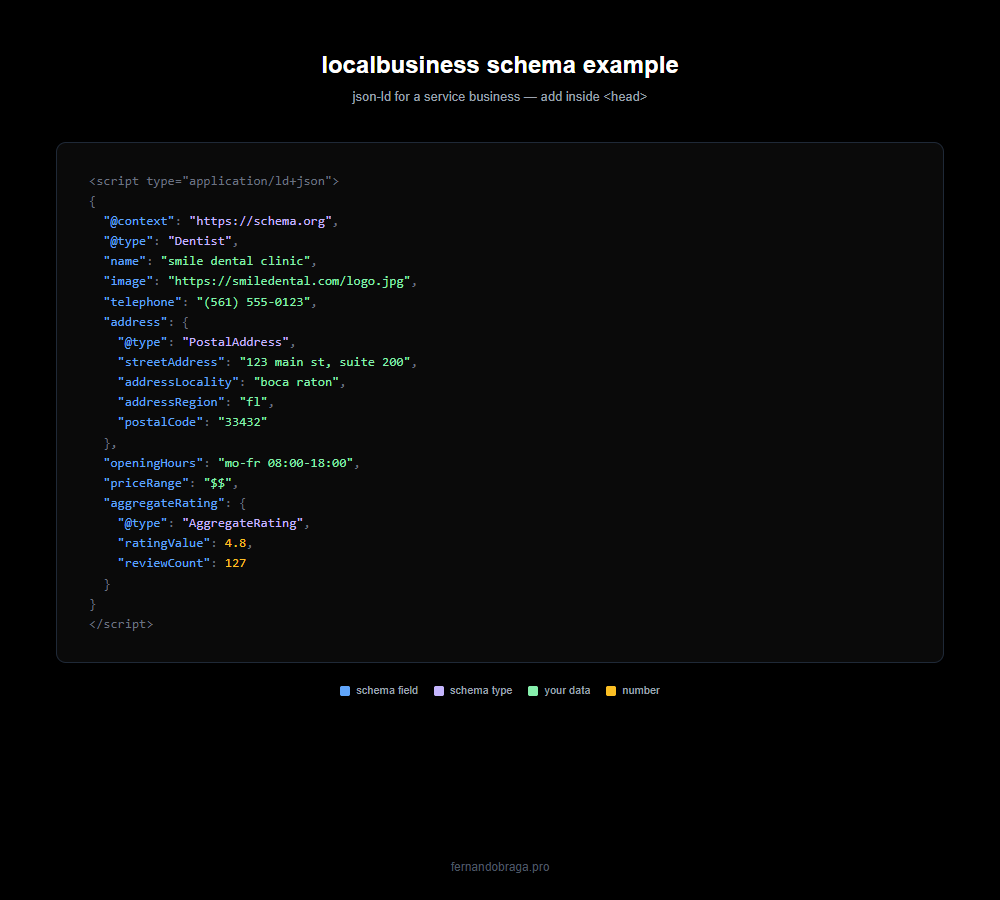
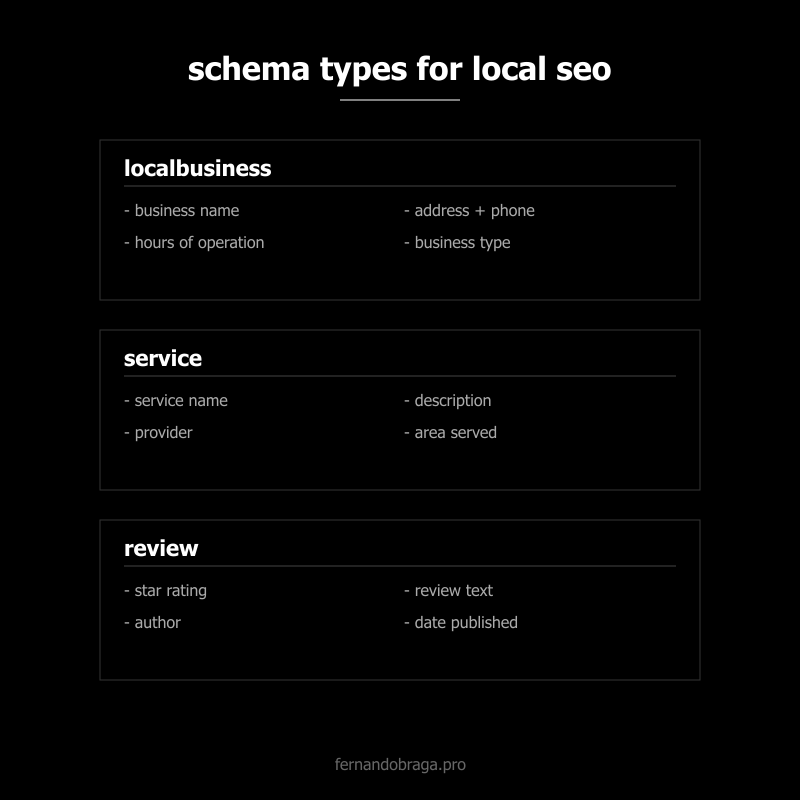
for local seo, three types of schema matter most.
localbusiness schema
this is the foundation. it tells google your business name, address, phone number, hours of operation, and what type of business you are. if you’re a dentist, you’d use the “dentist” schema type. if you’re a lawyer, you’d use “attorney”.
i use rankmath pro on every client site because it handles localbusiness schema without needing to touch code. you fill in the fields, and it generates the json-ld markup automatically.
service schema
service schema describes what you offer. it connects your services to your business entity and helps google understand the relationship between your service pages and your main business listing.
each service page should have its own service schema with a name, description, and provider (your business). this is especially useful for businesses that offer many different services, like clinics or law firms.
review schema
review schema can display star ratings in search results. those gold stars increase click-through rates significantly. you need real reviews on your site for this to work. google penalizes fake or self-written review markup.
the safest approach is to use a plugin that pulls your google reviews and adds the proper schema automatically. this keeps your markup valid and your reviews authentic.
internal linking strategy for service area pages
internal links connect your pages together and distribute authority throughout your site. for local businesses, the most important internal links connect your homepage to your service pages, and your service pages to your location pages.
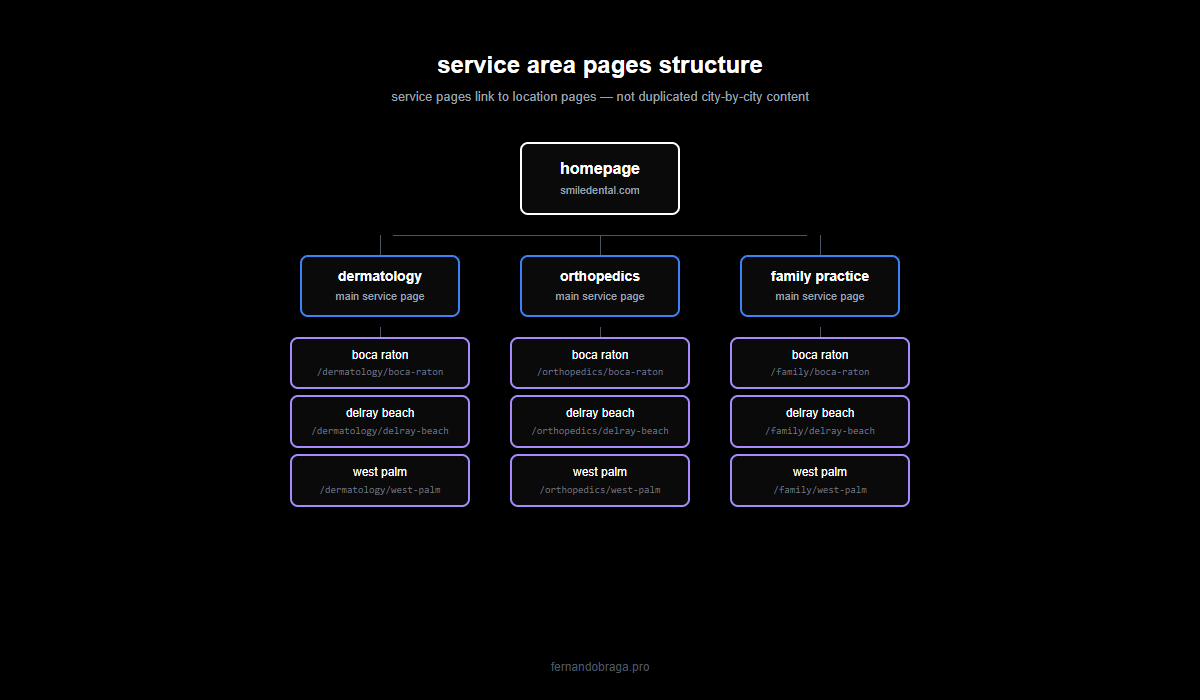
a solid internal linking structure looks like:
- homepage links to all main service pages
- each service page links to related service pages
- service pages link to relevant location pages
- blog posts link to service pages when mentioning those services
- location pages link back to the main service page
use descriptive anchor text. instead of “click here” or “learn more”, use “our teeth whitening services” or “dental services in boca raton”. this tells google what the linked page is about.
don’t overdo it. 3 to 5 internal links per page is a good range. more than that and you dilute the value of each link.
page speed and mobile optimization
over 60% of local searches happen on mobile devices. if your site is slow or hard to use on a phone, you’re losing potential customers before they even see your content.
the basics of page speed optimization:
- compress images (webp format, lazy loading)
- minimize css and javascript files
- use a caching plugin (wp super cache or wp rocket)
- choose quality hosting (shared hosting is fine for most local businesses)
- remove unused plugins and scripts
for mobile optimization, make sure your phone number is clickable (tap-to-call), your contact form is easy to fill out on a small screen, and your navigation menu works smoothly on mobile.
test your site with google’s pagespeed insights. aim for a score above 80 on mobile. perfect 100 isn’t necessary. fast enough to not lose visitors is the goal.
on-page seo isn’t a one-time task. as you add new services, expand to new areas, or update your business info, your website needs to reflect those changes. set a reminder to review your on-page optimization every quarter.
if you want a professional review of your site’s on-page seo, request a free audit. i’ll show you exactly what to fix and prioritize.