
if you’ve searched for a local service on google recently, you’ve seen the map pack. it’s the block of three business listings with a map that appears at the top of local search results. above the organic links. above the ads in many cases.
the map pack captures around 42% of all clicks on a local search results page. if your business isn’t in that top three, you’re invisible to nearly half the people searching for what you offer.
this guide walks through the five steps to get your business into the map pack based on how google’s local algorithm actually works in 2026.
what is the google map pack (and why it matters)
the google map pack (also called the local pack or 3-pack) is the section of search results that shows three local businesses on a map. it appears when google detects local intent in a search query. searches like “dentist near me,” “plumber in [city],” or “best coffee shop downtown” all trigger the map pack.
each listing shows the business name, star rating, number of reviews, address, hours, and sometimes a phone number or website link. users can click to get directions, call, or visit the website directly from the map pack.
the map pack sits above organic results. for local service businesses, ranking in the map pack often generates more calls and leads than ranking #1 in organic results. it pulls its data from google business profile. if you don’t have a properly optimized profile, you won’t appear in the map pack regardless of how good your website is.
the 3 factors that determine map pack rankings
google has publicly stated that three factors determine which businesses appear in the map pack.
relevance: matching your profile to searches
relevance is how well your google business profile matches what someone is searching for. this comes down to your primary category, secondary categories, business description, services listed, and the content on your website.
if someone searches “pediatric dentist in brooklyn” and your primary category is “dentist” with no mention of pediatric services, a competitor with the “pediatric dentist” category will outrank you. choosing the right google business profile categories is one of the highest-impact things you can do.
distance: the role of proximity
distance is how close your business is to the person searching. this is the one factor you can’t control. but distance is weighted against the other two factors. a business that’s farther away but has significantly more prominence can outrank a closer competitor.
prominence: reviews, links, and authority
prominence is how well-known and trusted your business is. google measures this through review count and rating, backlinks, citations, and overall online presence. this is the factor you have the most control over, and the five steps below focus primarily on building it.
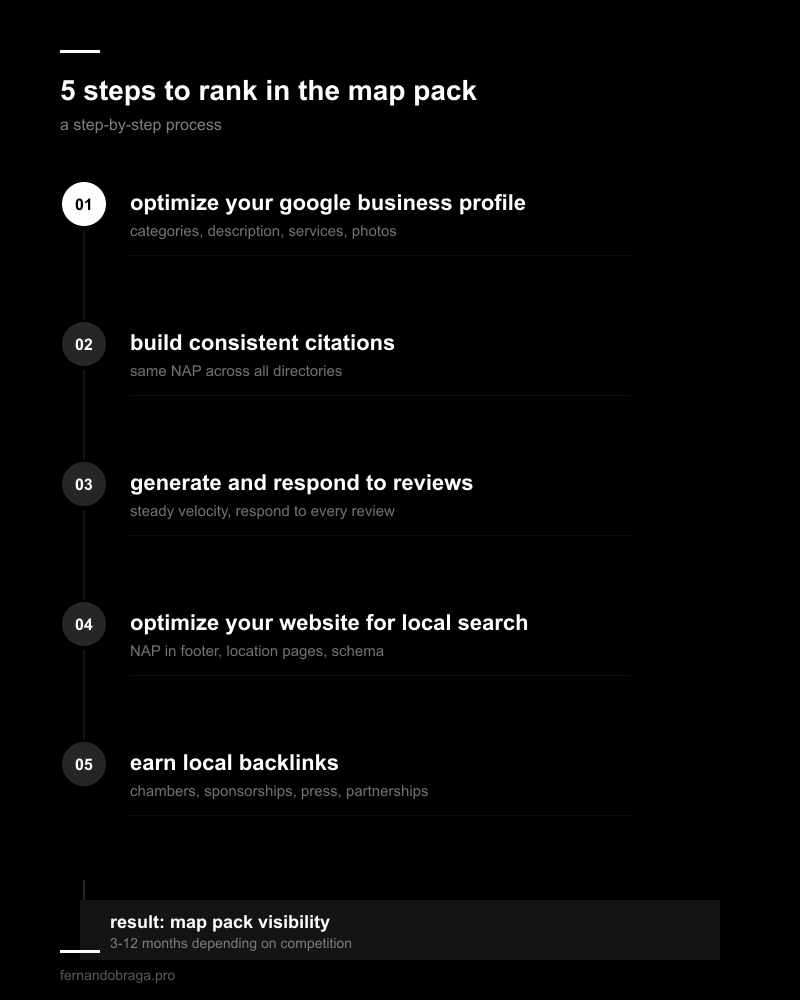
step 1: fully optimize your google business profile
your google business profile is the foundation of map pack rankings. here’s what “fully optimized” means.
choose the right primary category. your primary category is the single most important ranking signal for the map pack. it should be the most specific category that describes your core service. my guide on choosing the right GBP categories covers this in detail.
add all relevant secondary categories. secondary categories help you appear for related searches. don’t add categories for services you don’t offer.
write a complete business description. use all 750 characters. include your main services, service area, and what makes your business different.
list every service you offer. google’s services section lets you add individual services with descriptions. each service becomes a potential match for search queries.
add photos regularly. businesses with more than 100 photos get 520% more calls than average, according to google’s own data. upload real photos, not stock photos. add new ones at least monthly.
for a complete walkthrough, see my google business profile optimization guide.
step 2: build consistent citations
citations are mentions of your business name, address, and phone number (NAP) on other websites. consistency is what matters here. your NAP must be exactly the same everywhere.
start with the major platforms:
- google business profile
- apple maps / apple business connect
- bing places
- yelp
- facebook business page
then add industry-specific directories. if you’re a dentist, get listed on healthgrades and zocdoc. if you’re a lawyer, list on avvo and findlaw. niche directories carry more relevance weight than general ones.
audit existing citations. if your business has been around for a while, you probably have citations with outdated information. old phone numbers or inconsistent business names confuse google. find and fix these before building new ones.
my guide on local citations and their impact on seo covers which citations matter most.
step 3: generate and respond to reviews
reviews are one of the strongest map pack ranking factors. they affect both prominence and click-through rate.
ask consistently, not in bursts. google can detect unnatural review patterns. build a system where you ask every client after service completion. steady review velocity matters more than total count.
make it easy. create a direct review link and share it via text or email after appointments.
respond to every review. positive reviews get a personalized thank you. negative reviews get a professional, solution-oriented response. google has confirmed that responding to reviews improves your local ranking.
don’t incentivize reviews. offering discounts or gifts for reviews violates google’s policies. if caught, google can remove all your reviews or suspend your profile.
step 4: optimize your website for local search
your website supports your map pack ranking. google looks at it to verify your GBP information and assess your relevance for local searches.
NAP on every page. your business name, address, and phone number should appear in your footer. use the exact same format as your google business profile. mark it up with localBusiness schema.
create location-specific pages. if you serve multiple areas, create individual pages for each one. don’t just swap city names on a template. each page needs unique content.
optimize title tags and meta descriptions. include your city and primary service in your title tags.
embed a google map. embed a google map on your contact page to create an additional connection between your website and your GBP.
my on-page seo guide for local businesses walks through every optimization in detail.
step 5: earn local backlinks
backlinks remain one of the strongest ranking factors for both organic search and the map pack. for local businesses, the most valuable links come from local sources.
local organizations. join your local chamber of commerce and professional associations. most provide a member listing with a link to your website.
sponsorships. sponsor local events, sports teams, or community organizations. these typically come with a link on the organization’s website.
local press. build relationships with local journalists. a mention in a local news article carries significant authority.
partnerships. a dentist can partner with an orthodontist. a lawyer can connect with a chiropractor. cross-referrals often lead to natural link exchanges.
five links from relevant local sources are worth more than 50 links from random directories.
how long does it take to rank in the map pack
here are realistic timelines based on what i see across local seo campaigns.
new businesses (less than 1 year old): expect 6 to 12 months. the first few months focus on building the foundation with citations, reviews, and website optimization.
established businesses (1+ years): with proper optimization, expect map pack movement within 3 to 6 months.
competitive markets: in highly competitive markets like legal or healthcare in major cities, it can take 6 to 12 months even for established businesses.
what accelerates results: consistent review generation, regular GBP activity, quality local backlinks, and fixing citation inconsistencies. what slows results: NAP inconsistencies, a poorly categorized GBP, no local website optimization, and ignoring reviews.
tracking your map pack position
google business profile insights. GBP provides data on how people find your listing, what actions they take, and how your photos perform. check this monthly.
local rank tracking tools. tools like brightlocal, whitespark, or local falcon track your map pack position across different locations. map pack results vary based on the searcher’s location, so tracking from multiple points matters.
google search console. filter by queries containing your city name or “near me” to see local search performance trends.
track conversions, not just rankings. the real metric is how many calls, direction requests, and website visits your listing generates. connect map pack visibility to actual leads.
the map pack isn’t a one-time optimization. the businesses that consistently invest in their GBP, reviews, citations, website, and local links are the ones that maintain top positions.
if you want a clear picture of where your local seo stands and what steps will move you into the map pack, request a free audit and i’ll break it down for you.