“should we run google ads or facebook ads?” is one of the most common questions small businesses ask. the answer most marketing agencies give is “both!” because both generate commission for them. the honest answer depends on one specific thing about your business: whether people actively search for what you sell, or whether they only know they want it after you show them.
this article breaks down the actual difference between google ads and facebook ads (meta ads) for local businesses, when each wins, when each fails, and the framework for choosing where your first marketing dollar should go.
the one fundamental difference
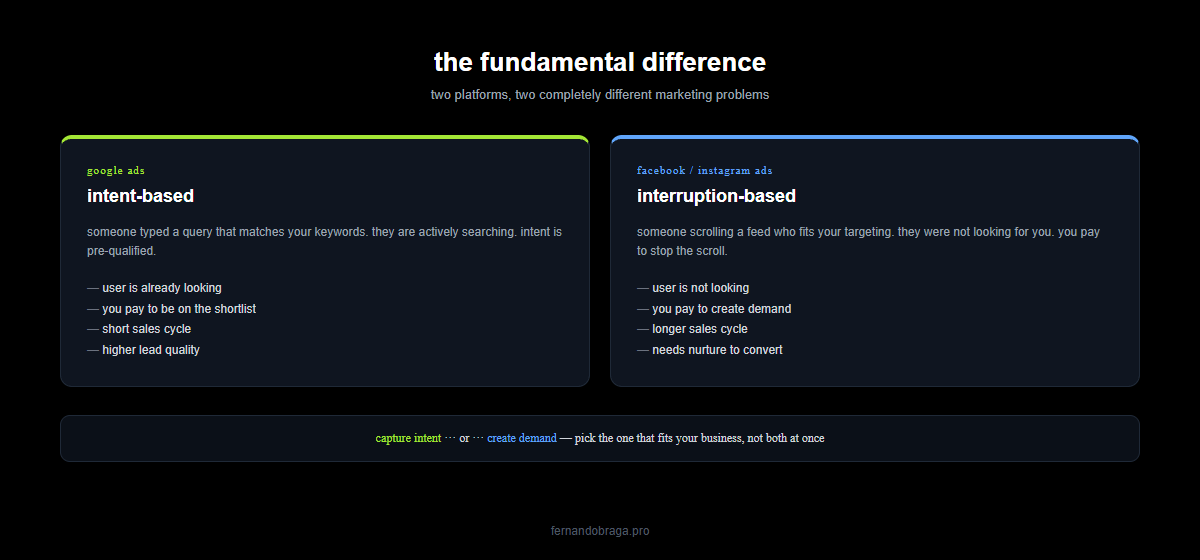
google ads is intent-based. facebook ads is interruption-based.
google ads shows your ad to someone who typed a query that matches your keywords. they are actively searching. the intent is pre-qualified. you pay to be one of the options at the moment they are already looking.
facebook ads shows your ad to someone scrolling through their feed who fits your targeting criteria. they were not looking for you. you pay to interrupt their scroll with something interesting enough to stop them.
those are two fundamentally different marketing problems. most of the disagreement about which is “better” comes from treating them as substitutes when they solve different challenges.
when google ads wins
google ads is the right first move when:
1. people actively search for what you sell. emergency plumbers, divorce lawyers, dentists, HVAC repair, roofing after storms. anyone with an urgent or specific need types it into google first. if there is search volume, there is an addressable market.
2. your service solves a defined problem. the customer knows they need a dentist, a lawyer, a plumber. they are not deciding whether they need the service — they are deciding who to hire. google ads puts you in that shortlist.
3. your deal size is high enough to afford the CPCs. some google ads keywords cost $5. others cost $150. the math works when customer lifetime value is 20x+ the cost per lead. for a $2,500 dental patient, a $30 cost per lead (from $5 CPCs and 15% landing page conversion) is a great deal. for a $15 t-shirt, it is not.
4. you need leads this month. google ads can generate leads within days of launching. no brand awareness to build, no audience to warm up. the search already happens — you just position yourself to capture it.
5. your business is local. geographic targeting in google ads is precise. zip code level. city level. radius around your location. for a plumber serving one suburb, google ads is built for you.
when facebook ads wins
facebook ads is the right move when:
1. people do not actively search for your service. cosmetic procedures that are nice-to-have, aesthetic services, personal training, meal prep services, coaching, online courses. people do not google “i should hire a personal trainer” — they see content on instagram that makes them want one.
2. your product is visually compelling. food, fashion, aesthetic results, fitness transformations, jewelry, interior design, automobiles, real estate. facebook and instagram are visual-first platforms. if you can show a stunning photo or before/after, the platform works. if your service is hard to photograph (insurance, legal consulting), it does not.
3. you have a well-defined demographic. facebook’s targeting by age, location, interests, behaviors is powerful when your customer fits a pattern. “women 35-55 in miami interested in yoga who shop at lululemon” is findable. “anyone with a roof” is not.
4. you need to build demand, not just capture it. a new service nobody is searching for yet (new tech, new concept, new business category) has no search volume. facebook ads lets you introduce the concept and create the demand.
5. your business has strong visual content already. real photos of clients, real videos of you delivering the service, real results. facebook rewards authentic content and punishes stock-looking ads. if you do not have the content library, facebook ads is expensive and slow to work.
the CPC and CPL reality
rough economics across both platforms for local service businesses:
google ads:
- CPC range: $2 to $150+ depending on industry and metro
- conversion rate on landing pages: 5-15% typical
- CPL range: $30-200 depending on industry
- lead quality: high (they were searching for you)
- sales cycle: short to medium (urgent or semi-urgent intent)
facebook/instagram ads:
- CPC range: $0.50 to $3 (much cheaper clicks)
- conversion rate on landing pages: 1-5% (cold traffic)
- CPL range: $40-300 depending on funnel quality
- lead quality: variable (they were scrolling, not searching)
- sales cycle: medium to long (need to warm up)
the math often looks similar on cost per lead between the two platforms. the difference is lead quality and sales cycle. google ads leads close faster and at higher rates because they were actively looking. facebook ads leads require nurture and marketing sequences to convert at the same rate.
the common mistakes
1. running facebook ads for urgent-search services. a plumber running facebook ads during business hours targeting “homeowners 35-65” is wasting money. the person with a burst pipe is on google, not scrolling instagram. match the platform to the search behavior.
2. running google ads for impulse products without search volume. a boutique selling $40 candles bidding on “luxury candle” keywords is fighting for 300 monthly searches across the entire US. facebook + instagram shows those candles to millions of people who never thought about buying one but want one after seeing them.
3. copy-pasting ads between the two platforms. the creative and copy that work on google (specific, direct, immediate benefit) fail on facebook. the creative that works on facebook (scroll-stopping visual, storytelling, curiosity) fails on google. different platform = different ad strategy.
4. splitting a small budget 50/50 across both. $500/month on google ads generates meaningful data. $500/month split into $250 on each generates noise on both. if budget is tight, commit to one, prove ROI, then expand.
5. using the same landing page for both. google ads traffic is ready to convert immediately (they searched for you). facebook ads traffic needs context, storytelling, and more information before converting. separate landing pages for separate intent.
when to run both
once either platform is profitable on its own, running both creates multiplier effects. common playbooks:
google captures, facebook remarkets. a visitor clicks your google ad but does not convert. facebook ads then shows them follow-up content (testimonials, case studies, offers) to bring them back. conversion rate across combined funnel can be 2-3x higher than either alone.
facebook builds awareness, google captures intent. a cosmetic dermatologist runs instagram ads showcasing results. prospects become interested, then later search “botox near me” and click the dermatologist’s google ad. the combined effect: awareness-to-conversion funnel with attribution spread across both platforms.
seasonal overlay. a landscaper runs google ads all year for urgent searches (“tree removal emergency”) and facebook ads in spring to build demand for seasonal upgrades (new lawn, garden design, outdoor lighting).
how to decide for your business
use this 4-question framework:
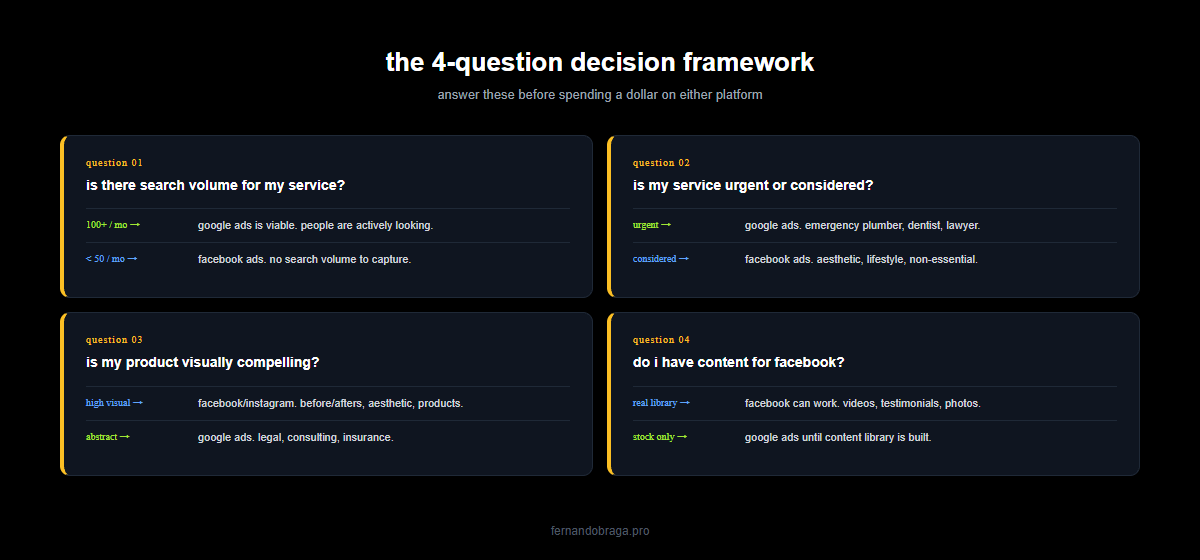
1. is there search volume for my service?
check google keyword planner. if there are 100+ monthly searches for your service in your area, google ads is viable. if under 50, facebook ads is probably better.
2. is my service urgent or considered?
urgent (emergency services, acute pain points): google ads.
considered (aesthetic, lifestyle, non-essential): facebook ads.
3. is my product visually compelling?
high visual appeal (before/afters, aesthetic services, products): facebook/instagram ads.
abstract service (legal, consulting, insurance): google ads.
4. do i have content for facebook?
real photos, videos, testimonials, behind-the-scenes: facebook ads can work.
only stock photos and logos: google ads until you build the content library.
if the answers point to google ads, start there. if they point to facebook ads, start there. do not try to do both until one is profitable and you have budget to experiment with the other.
the answer most local service businesses want
90% of local service businesses i work with (dentists, lawyers, plumbers, contractors, medical clinics, veterinarians) get better ROI from google ads than from facebook ads in the first 12 months. the search volume exists, the intent is urgent, and the economics favor intent-based advertising.
the exceptions are aesthetic, cosmetic, and lifestyle services (medical spas, cosmetic dermatology, fitness coaches, luxury home services, personal shopping) where visual appeal drives consideration and facebook/instagram often generates cheaper qualified leads.
if you are unsure which category you fall into, start with google ads. it is easier to diagnose, easier to optimize, and the economics are more forgiving for small budgets.
next step
if you want a specific read on which platform fits your business, what budget is realistic, and what you should test first, start with a free audit. i walk through your service, your market, and your current marketing to recommend the platform and approach that actually fits your situation.